

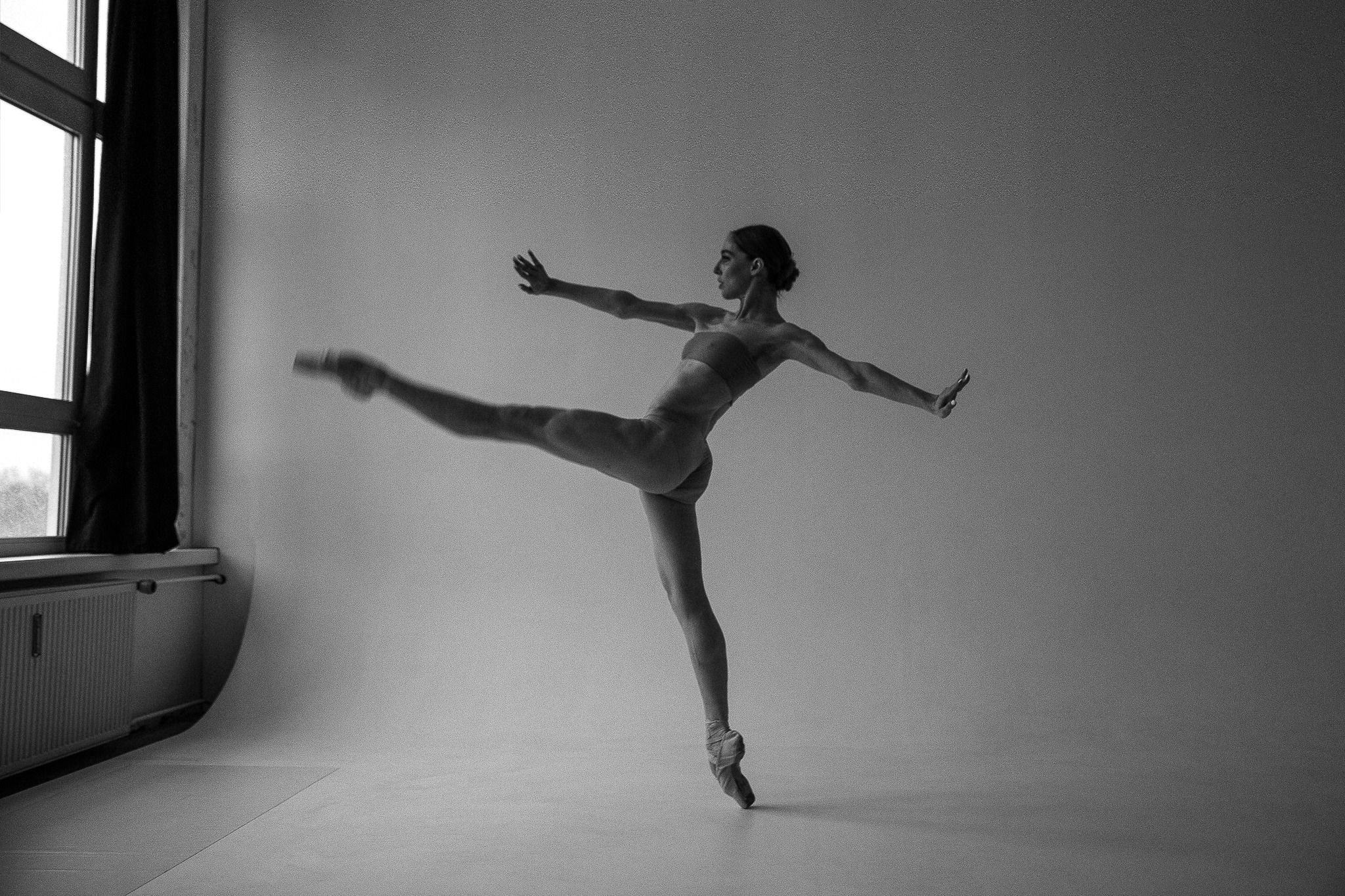
Step beyond the traditional stage and into the evolving world of movement. In our latest interview, choreographer and founder of DANCÆ, Soraya Schulthess, reflects on bridging classical ballet with club culture, immersive performance, fashion and technology.

We talked about choreography beyond convention, the role of AI as a creative catalyst, the body as a space of human expression, and why the future of dance lies between preservation and transformation.
Classical ballet, intuition and electronic music
Your artistic journey began within the world of classical ballet, including your training at the Bolshoi Ballet Academy and your work with the Boris Eifman Ballet and Deutsche Oper Berlin. How did this highly structured tradition shape your understanding of the body, discipline, and storytelling through movement?
Classical ballet shaped almost everything about how I initially understood movement. It teaches you to see the body with an incredible level of precision, where every detail has meaning, from the placement of a hand to the direction of the eyes. You become very aware of how even a small physical choice can completely change what an audience reads.
Discipline was obviously a huge part of that training as well. In Russia especially, the level of intensity taught me that my physical and mental capacity was much greater than I thought it was. That has stayed with me as an artist – because creativity isn’t always about waiting for inspiration. A lot of it is having the discipline to keep working until something becomes what you imagined.
Ballet also gave me a very strong understanding of how movement can tell a story without language. The body can communicate relationships, emotion, tension and intention before anything is spoken. Even though the work I make now looks different from traditional classical ballet, that understanding of the body as a storytelling instrument is still fundamental to the way I create.
At what point did you feel the need to move beyond classical ballet conventions and explore new forms of expression through contemporary movement, electronic music, and technology?
It was gradual. I had a very serious injury in my late twenties, which forced me to step back and reconsider my relationship to dance. Until then, almost my entire life had existed within the framework of ballet.
At the same time, living in Berlin exposed me to completely different artistic worlds: electronic music, installation art, fashion, nightlife. I became increasingly interested in creating ballet works inside and for other contexts.
It wasn’t really about rejecting ballet, it was more about realizing that ballet could be the foundation of my work, while combining it with many other artistic disciplines.
Classical ballet is often associated with precision, hierarchy and tradition, whilst club culture represents freedom, improvisation, and collective energy. What fascinated you about bringing these seemingly opposite worlds together?
I actually think they’re much more connected than they first appear.
Ballet is extremely controlled. The body is trained until almost everything becomes legible, shaped and intentional. On a dancefloor, especially within electronic music, you almost have the opposite experience: you surrender some of that individual control to rhythm, repetition, bass and the collective energy around you.
But both are ultimately about overcoming the uncertainty of our bodies. Ballet through physical control and the dance floor though collective release. They just arrive there through opposite means. That tension between control and surrender is something I’m very interested in.
Do you see DANCÆ as a rebellion against classical dance structures, or rather as an evolution of the tradition?
Definitely more as an evolution. I’m interested in placing ballet vocabulary in contexts where we’re not used to seeing it, allowing it to interact with completely different forms of music, art and culture. For me, it’s about expanding the possibilities of what ballet and dance can be.
The Birth of DANCÆ & Ballet Sur_real
DANCÆ combines dance, electronic music, immersive installations and new technologies. What was the original artistic question that led to creating this platform?
The original question was probably very simple: why does dance have to exist primarily within the structures we already associate with it?
I was interested in what happens when choreography is placed in dialogue with installation art, electronic music, architecture, fashion and technology, and when all of those things are treated as equally important parts of the work.
I also wanted to create experiences that people who don’t normally go to contemporary dance or ballet could enter without feeling that they needed a particular education to understand them. A moving body is something everyone understands.
The ensemble Ballet Sur_real creates a dialogue between ballet vocabulary and electronic music. What does techno offer dance that classical music traditionally cannot?
Electronic music creates a very different relationship between the body and time. In classical music, choreography often follows a musical architecture that has narrative development, phrasing and resolution. Electronic music can be much more relentless. Repetition creates this strange situation. Very little is changing, yet your perception is constantly changing. I also think it creates a physical response before an intellectual one. You feel bass in your body before you think about it.
For choreography, that opens up a completely different space. The music can be highly repetitive while still taking unexpected turns, which allows themes to develop more gradually and evolve in more surprising ways.
In many of your performances, club culture appears not just as an aesthetic reference. It is a social space with its own rituals and emotional dynamics. What aspects of club culture are you most interested in exploring?
What interests me about club culture is that it’s one of the few spaces where people really let their guard down. There are still social codes and rituals around how people dress, move and interact, but at the same time, something much more instinctive can come out.
People become less controlled, more expressive, I would say more animalistic. I find that really interesting, especially in contrast to ballet, where the body is so highly trained, controlled and codified.
So for me, club culture isn’t just an aesthetic reference, it’s a space where you can observe what happens when people move between control and surrender, individuality and collective energy. In those tensions I find a lot of inspiration.
Berlin has historically been a place where underground culture, technology, and artistic experimentation intersect. How has the city influenced DANCÆ’s identity?
As an artist, you’re constantly taking different pieces of your life and experiences and putting them together into something that eventually becomes uniquely yours. For me, my background in ballet, coupled with my experience of Berlin’s cultural scene, naturally led to the work I’m making today.
Berlin also has an unusual amount of crossover between disciplines. An electronic musician collaborates with an installation artist, who works with a fashion designer, who enters a performance space. Those worlds aren’t as separated here. That made me think much less about choreography as simply arranging movement. The architecture, installation, lighting, sound, and even the audience can all become part of the choreography.
Interconnected: AI, Technology & Creativity
In your performances, you work with an AI agent that generates choreographic prompts in response to dancers’ movements, timing, and spatial decisions. How did this collaboration between human performers and artificial intelligence begin?
It actually began with Chlär. He was interested in centering the theme of the work around something dystopian and related to technology, the reference was black mirror. From there we started exploring the idea of doing the piece on AI, showing both it’s negative and positive aspects.
The AI wasn’t really operating as a live autonomous agent during the performance. However, we used it as part of the choreographic development process. It generated prompts and introduced ideas that the dancers then had to interpret physically. There were also comedic elements, referencing the overly positive and excited way LLM’s respond to users’ queries.

It was a very interesting process because it made me think much more deeply about what creativity actually is. When an AI gives you an idea that you wouldn’t necessarily have arrived at yourself, where does the creativity lie? Is it in generating the idea, in choosing what has value, or in how a human interprets and transforms it?
For me, the most interesting part became less about the technology itself and more about the questions it raised around authorship, instinct and what we actually mean when we call something creative
Many people view AI as something that could replace human creativity. Your work seems to approach it differently — as a partner or provocateur. How do you define the role of AI within your creative process?
I think AI becomes interesting when it makes us question our own behaviour, rather than when we simply use it to imitate something humans already do. Of course, I could ask it to generate a storyline or suggest tracks for a choreography, but I use it more as a tool for critiquing and challenging my ideas.
In that context, I find it incredibly useful. As a creative, your ideas can often exist within an echo chamber inside your own head. Having an outside source examine them, question them and offer a different perspective helps enormously with honing and refining the work.
For this particular work with Chlär, the central question became: if human thought and behaviour can be reduced to data points, to what extent can an algorithm predict which image you will click on, which person you will be attracted to, what music you will listen to, or what kind of behaviour will hold your attention?
That raises deeper questions about instinct, autonomy and free will. These questions became the groundwork for what we explored in the work, and opened up artistically fertile territory around the tension between human agency and algorithmic prediction.
When an AI system suggests a movement or choreographic direction, what happens emotionally for the dancer? Does it create curiosity, resistance, vulnerability, or something else?
I think the most interesting situation is when an external system interrupts a dancer’s habitual decision-making. Dancers develop enormous amounts of physical intelligence, but we also develop habits. We have movements we naturally choose and patterns we return to.
Whenever something disrupts that, whether it’s technology, another person, an installation or a spatial restriction, there’s a moment where the dancer has to negotiate between instinct and instruction.
That negotiation can create very interesting movement because you’re no longer completely in control.
Dance is one of the most human art forms because it is based on physical presence, imperfection, and emotion. What remains uniquely human when a machine becomes part of the creative process?
The body. Every choice physically costs something; the body gets tired, injured, excited, is aware of it’s mortality. A machine can generate an idea about a body, but it can’t inhabit a body in that way. For me, that difference is enormous. The vulnerability of having to physically live through an experience is something fundamentally human.
Your work raises the question: If creative choices can be predicted or optimized, what remains unpredictable about human expression? How would you answer that question?
I think contradiction remains unpredictable. Human beings very rarely behave according to what is objectively best for us; we repeat mistakes, we desire things we know are bad for us, we change our minds, we sabotage ourselves, we fall in love with the wrong person.
That irrationality is often where something genuinely human appears. Maybe the interesting thing about human expression isn’t that it can’t be predicted at all, but that there is always the possibility of acting against the prediction.
Is AI expanding the imagination of choreography, or do you think artists need to be careful not to let technology define the boundaries of creativity?
Both. Every new technology expands what artists can do, but technology is only interesting when there’s an artistic reason for it to be there. I’m not interested in using AI, projection, lasers or any other technology simply because it looks contemporary, otherwise technology becomes decoration.
The question always has to come first. Technology should allow you to investigate something that you couldn’t investigate in quite the same way without it.
Do you believe future dancers will need new skills — not only physical and artistic training but also technological literacy?
Absolutely, although I don’t think dancers need to become programmers. What is changing is the environment in which performance exists. Dancers are increasingly working with cameras, sensors, immersive sound, interactive installations and unconventional performance spaces. So I think adaptability will become increasingly important.
The dancer of the future isn’t simply someone who can execute choreography extremely well. They’re someone who can understand and respond intelligently to an entire system around them.
Body, Identity & Society
Many of your works explore themes such as identity, desire, digital spaces, and the way people perform themselves in contemporary society. Where do these themes come from personally and artistically?
I think I’m very interested in the distance between who we think we are and how much of that identity is actually constructed by everything around us. We’re constantly performing versions of ourselves, both online and offline. We learn what is desirable, successful, attractive or acceptable, and then consciously or unconsciously begin shaping ourselves in response.
I’m interested in the moments where that constructed identity begins to break down and something less controlled appears underneath it. Dance is an interesting medium for that because the body often reveals things before language does.
In Modalities of Me, you explore how modern love and identity are shaped by digital environments, curated personas, and social expectations. How has technology changed the way humans experience intimacy and connection?
Technology has given us almost unlimited access to other people while simultaneously creating more distance between us. We can constantly observe one another, evaluate one another, and try to optimise for the “best” possible partner. A strange consumer logic has entered intimacy.
I think this seemingly unlimited access to everyone, combined with the constant comparison created by social media, has produced a kind of perfect storm. We are left with the feeling that we never quite have what we want, that someone else could always be better, and that connection and intimacy exist in endless supply.
But that is not actually true. In some ways, this illusion has also made us emotionally lazy. We are less willing to work through difficulty or make a real effort for another person because there is always the sense that there is more where that came from, and perhaps something even better.
On top of that, we are constantly in a kind of performance mode, curating how we appear and how we are perceived. That inevitably changes intimacy, because true intimacy requires moments in which you stop controlling the image and allow yourself to be genuinely seen. That tension–between wanting to be loved and continually managing the version of ourselves that is available to be loved–is central to Modalities of Me.
Dance has always been connected to questions of identity — who is allowed to move, who is represented, and whose bodies are visible on stage. How do you approach inclusivity and representation within your work?
For me, it starts with questioning what kinds of bodies and movement languages we instinctively consider valuable. Dance has historically created very rigid hierarchies around bodies, particularly ballet. I come directly from that world, so I’m very aware of it.
I’m interested in bringing different movement languages and different kinds of performers into the same artistic universe without necessarily asking one to imitate the other. Inclusivity becomes meaningful when difference actually changes the work, rather than simply being represented visually.
Classical ballet has historically been connected to strict ideals of beauty and physical perfection. How do you challenge or rethink those ideals through DANCÆ?
What’s interesting is that I still find the ballet-trained body incredibly beautiful. What I’m questioning is the context in which we’ve been taught to understand that beauty. When you remove ballet from the theatre, remove the tutu, the narrative, the hierarchy and the classical score, suddenly you see that body differently. It can become strange, vulnerable, sexual, mechanical or almost alien. I’m interested in taking something familiar and changing the conditions around it until we can see it again.
Do you think contemporary performance has a responsibility to comment on social and political realities, or should art remain an open space for personal interpretation?
I don’t think every artwork needs to make a political statement, but I also don’t think art can ever exist completely outside the society that produces it. Even choosing what bodies you put onstage, what spaces you perform in and who has access to the work reflects certain values. For me, the strongest work doesn’t necessarily tell the audience what to think. It creates a situation where you experience something and then have to confront your own response to it.
Fashion, Performance & Esther Perbandt Collaboration
DANCÆ performed during Esther Perbandt’s Blackhearts presentation. Fashion and dance both communicate through the body, but in very different ways. What interested you about this collaboration?
What I find interesting about fashion is that clothing can completely transform the meaning of a body without the body itself changing. Esther has such a strong visual universe, so it wasn’t about simply putting dancers into clothes and having them perform choreography, it was about understanding the world she had created and asking how movement could inhabit it.
How do costume, material, and visual identity influence the way dancers inhabit movement?
The moment you put something on a dancer’s body, you change not only the way others perceive them, but also the way they perceive themselves, which changes the way they move.
Something restrictive creates one physical psychology, while nudity or transparency creates another. A heavy material changes movement completely differently from something almost invisible. Costume isn’t something I think of as being added after the choreography. It become part of what generates the choreography.

Fashion shows often create temporary worlds rather than simply presenting garments. How do you approach creating an atmosphere and emotional narrative within a limited timeframe?
You have to be very precise. You don’t necessarily need a long narrative to create an emotional progression, sometimes one image, followed by another image at exactly the right moment, can completely change how an audience feels.
Sound, lighting, spatial relationships and the rhythm of entrances and exits all become choreographic tools. You’re essentially compressing an entire world into a very limited amount of time.
What possibilities do collaborations between fashion designers, choreographers, musicians, and technology artists create for the future of performance?
They allow us to create things that don’t just belong to one category. When choreography, music, installation, fashion and technology are genuinely developed together, you stop asking whether something is a dance performance, an exhibition, a concert or a fashion presentation. It almost becomes its own form. I think audiences are increasingly open to those hybrid experiences.
The Future of Dance & Art
Where do you see the boundaries of dance expanding over the next decade?
I think dance will become increasingly spatial rather than simply frontal. The idea that an audience sits in one place and watches performers in another is only one possible relationship. We are already seeing choreography move into galleries, clubs, public spaces, digital environments and immersive installations.
Do you think we are moving toward a future with increasingly interactive performances? Will audiences, technology and performers influence each other in real time?
Yes, although I think interaction needs to mean more than asking an audience member to walk through a space or participate in something, what’s interesting is situations where the presence and behavior of the audience genuinely changes the work. I think the boundaries will continue to expand as dance becomes less defined by a particular stage or format, and more by the kinds of experiences movement can create.
What role do you think independent artistic platforms like DANCÆ play in creating alternatives to traditional cultural institutions?
Independent platforms can in some ways take more risk. Large institutions are incredibly important, but they’re also complex structures with histories, audiences and expectations that they have to negotiate. Being independent allows us to move between different worlds much more freely and that flexibility allows new forms to develop.
What would you like audiences to take away emotionally after experiencing a DANCÆ performance?
I don’t necessarily want everyone to leave having understood exactly the same thing. I want people to feel something physically before they’ve completely intellectualized it. Ideally there is an image, sensation or question that stays with them afterwards and that they can’t immediately resolve. That lingering feeling is much more interesting than delivering a clear message.
Finally: What question about the future of art do you think we are currently not asking enough?
Maybe: How much of what we call choice is actually still ours?
We’re very focused on what technology will be capable of creating. I’m more interested in what technology is already doing to the person experiencing the art. How our attention is being shaped, how our desires are being predicted and how our behaviour is being influenced? Before asking whether machines can become more human, I think we should also be asking what kind of humans our machines are teaching us to become.
Your work exists between past and future, between centuries-old ballet traditions and emerging technologies. What part of yourself do you find reflected most strongly in that space between preservation and transformation?
Probably the contradiction between wanting control and wanting freedom from control. Ballet gave me an enormous amount: discipline, physical knowledge, precision and a very particular understanding of beauty. I wouldn’t be the artist I am without it.

At the same time, I’ve always been curious about what exists outside the structure I’m already in. I think that’s why I’m drawn to this space between preservation and transformation. I’m not interested in abandoning the past, but I’m also not interested in repeating it. For me, the exciting part is taking everything you’ve inherited and asking: what else can this become?
You must be logged in to post a comment.