

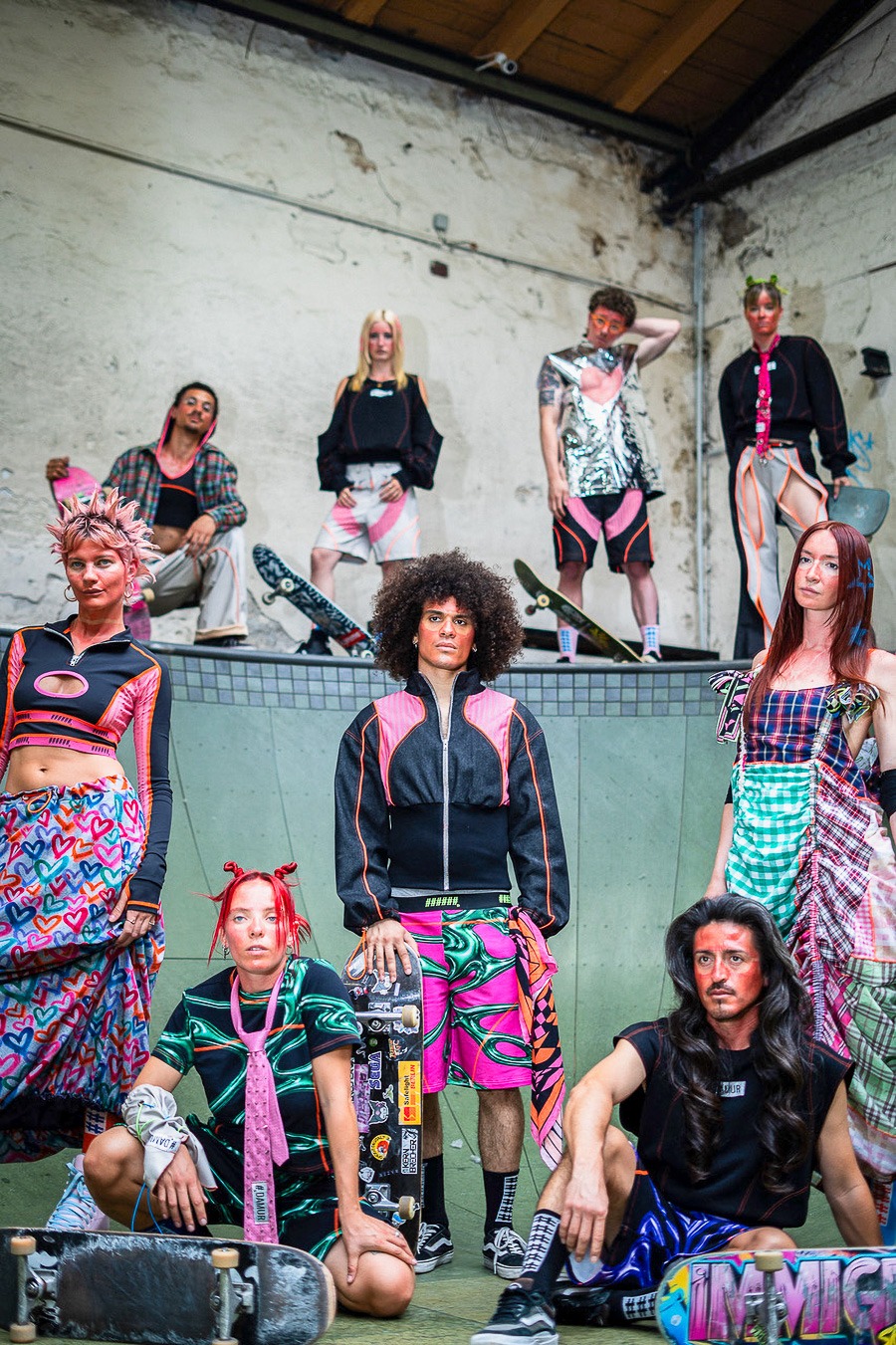
Fashion presentations increasingly blur the boundaries between performance, installation and social experience. Yet few collections at Berlin Fashion Week Spring/Summer 2027 dissolved these categories as radically as #DAMUR’s latest presentation. Berlin-based designer Damur Huang did more than stage another conventional runway. He transformed Skatehalle Berlin into an immersive environment. In this space, fashion, skateboarding, dance, techno, and the community coexisted simultaneously.

Presented under the title Ride Chaos – Break the Gravity, the collection became part of TECHNO SLUTs—a ten-hour cultural programme that replaced passive spectatorship with active participation. The audience did not simply observe garments. They shared the same space with models, dancers, skaters, and musicians. Together, they continuously interacted and challenged established ideas of how fashion can be experienced.
Fashion Beyond the Runway
Instead of separating performers from viewers, #DAMUR eliminated the traditional hierarchy of the fashion show. Models navigated the concrete landscape of Skatehalle Berlin alongside skateboarders weaving through the audience, while dancers translated electronic rhythms into physical movement.
The presentation unfolded in three distinct acts. Dance introduced the collection through rhythm and tension before transitioning into the runway itself. Finally, skateboarders entered the space, placing the garments within an environment defined by speed, impact and constant motion. Rather than ending with a finale walk, performers and audience merged into a collective celebration that seamlessly evolved into the night’s rave.
Ballet Meets Skateboarding
At the conceptual core of Ride Chaos – Break the Gravity lies an unexpected dialogue between ballet and skateboarding.

Although these disciplines appear fundamentally opposed, both rely on discipline, repetition, balance and resilience. One seeks to conceal the fall, while the other embraces it as part of its aesthetic language. #DAMUR translates this tension into garments that respond to movement instead of restricting it.
The collection combines oversized tailoring with technical sportswear, sculptural outerwear, second-skin layers, cropped silhouettes and flexible constructions. Stretch panels, exposed cut-outs, and dynamic seams give each look the ability to change with every jump, turn, and recovery. Movement itself is placed as the collection’s defining design principle instead of athletic functionality.
A Distinct Visual Language
Visually, SS27 continues #DAMUR’s established design vocabulary while introducing new contrasts.

Neon orange piping traces the body like kinetic lines across technical fabrics, while chrome finishes reflect light with an almost industrial intensity. Checkerboard patterns collide with plaids, vivid pinks confront saturated oranges and metallic silver interrupts monochromatic black.
Throughout the collection, softness and protection coexist. Heart motifs appear beside technical tailoring, sculptural jackets accompany second-skin garments and oversized scarves soften sharply constructed silhouettes. The result is neither sportswear nor couture in the traditional sense, but a form of gender-fluid armour designed for bodies constantly in motion.
Fashion as Cultural Infrastructure
Beyond its garments, Ride Chaos – Break the Gravity also questions the rituals of contemporary fashion itself.


Rather than presenting fashion as a carefully controlled spectacle, #DAMUR situates it within spaces where youth culture, nightlife and creative communities already exist. The skatepark becomes both venue and metaphor—a place defined by experimentation, risk and shared experience.
In doing so, the collection challenges the industry’s reliance on highly curated environments that often reference subcultures only after they have become commercially acceptable. Here, fashion unites with sound systems, physical movement, and collective participation. This suggests that contemporary cultural relevance cannot be achieved through aesthetics alone.
TECHNO SLUTs: Sound as Part of the Collection
The accompanying TECHNO SLUTs programme functioned as far more than entertainment between runway looks.
Curated by Damur Huang, the ten-hour event featured DJ sets and live performances from Ceață, Alienata, Schwefelgelb and Paul Ray, creating an evolving sonic landscape that directly influenced how the collection was experienced. Rather than acting as a soundtrack, the music became an integral component of the presentation, transforming the garments through rhythm, atmosphere and collective energy.
A Reflection of Berlin’s Creative Ecosystem
The event also highlighted the collaborative nature of Berlin’s independent creative scene. Technical production, hairstyling, local food initiatives and community partners all contributed to an experience that felt closer to a neighbourhood cultural gathering than an exclusive industry presentation.
This collaborative approach strengthens #DAMUR’s longstanding position within Berlin’s intersection of fashion, nightlife, and queer culture. In this context, clothing functions less as a luxury commodity. Instead, it serves as a medium for identity, visibility, and community-building.
However…
Despite its compelling exploration of movement, community and subculture, the presentation also raised an uncomfortable question. The heavy use of vivid red facial makeup on several models inevitably recalled historical practices of “redfacing”—the theatrical caricaturing and stereotyping of Indigenous peoples.
Whether intentional or not, such visual references carry cultural and colonial histories that cannot be separated from their contemporary reception. In a fashion landscape increasingly committed to cultural awareness, symbolism matters as much as intention, and aesthetic experimentation benefits from a critical engagement with the histories it may inadvertently evoke.

You must be logged in to post a comment.