

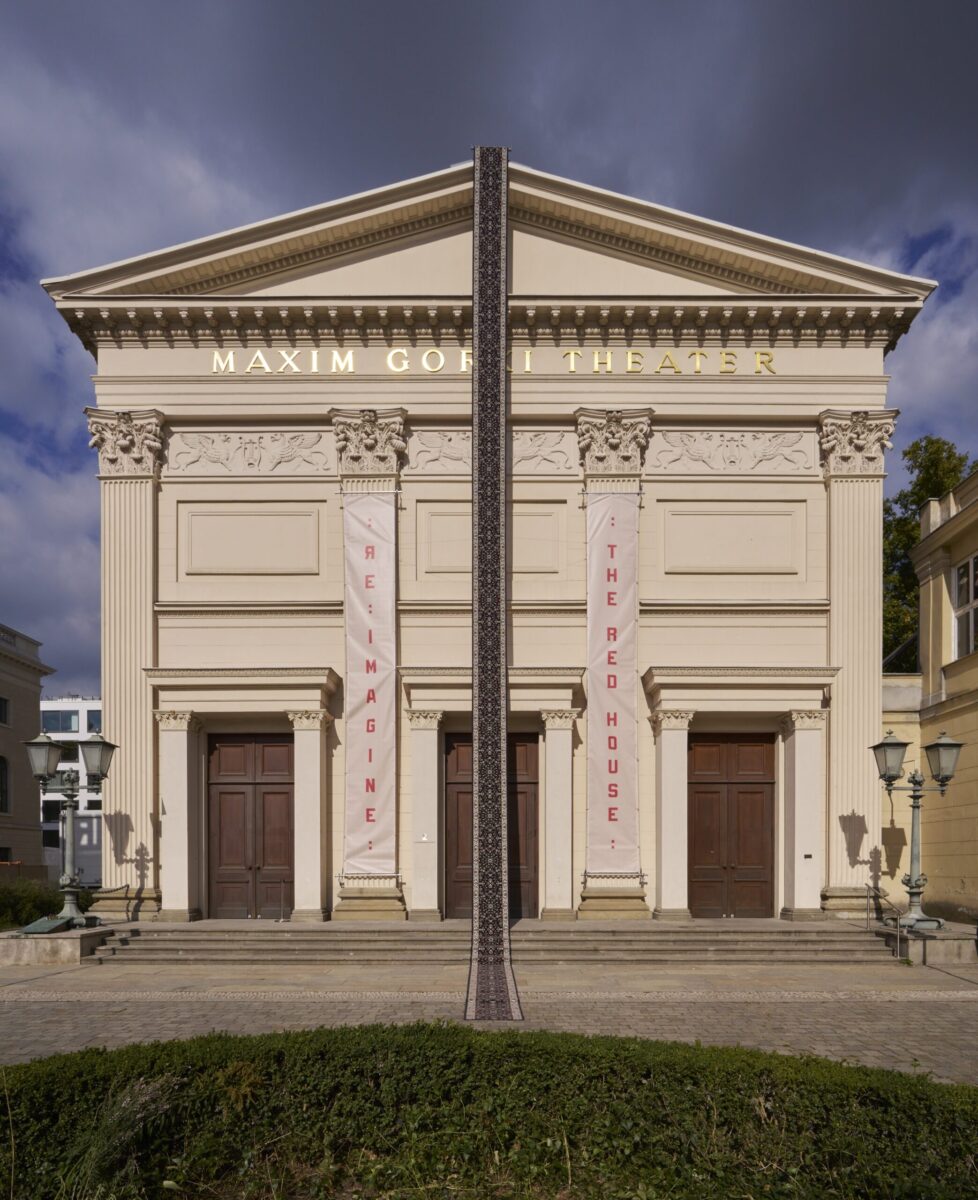
By all appearances, the Maxim Gorki Theater is entering its next chapter under imperfect conditions: construction work, shrinking budgets, spatial limitations, and the instability that increasingly defines contemporary cultural institutions. Yet for incoming Artistic Director Çağla Ilk, these conditions are not obstacles to overcome but the very material from which a new theater can emerge.
Standing before journalists at the Palais am Festungsgraben on May 12, Ilk opened the presentation of the 2026/27 season with a sentence that immediately framed her curatorial vision in deeply personal terms: “Today is my 3,271st working day at the Maxim Gorki Theater.” It was less a ceremonial introduction than a declaration of continuity. Ilk is not arriving as an outsider intent on reinvention. She is returning to an institution that shaped her artistic and political imagination — and one she now intends to transform into something radically porous, transdisciplinary, and alive.
The new Gorki, as Ilk describes it, is not simply a repertory theater. It is conceived as an organism: a space where theater, visual art, architecture, sound, choreography, political discourse, memory work, and urban experience intersect without hierarchy. It is a house that refuses distinctions between stage and exhibition, between performance and installation, between local realities and global imaginaries.
And perhaps most importantly, it is a theater that listens.
A Theater Built on Thresholds
Ilk’s artistic language has long revolved around thresholds — architectural, political, emotional, and institutional. Trained as an architect in Berlin and Istanbul before becoming one of Germany’s most influential transdisciplinary curators, she has consistently worked in spaces where categories collapse. Her projects at the Maxim Gorki Theater between 2012 and 2020, particularly within the Berliner Herbstsalon, already challenged conventional theater structures by inviting visual artists, musicians, choreographers, and theorists into theatrical space.
Her later tenure at the Staatliche Kunsthalle Baden-Baden further sharpened this curatorial approach. There, sound became not merely accompaniment but a political medium; exhibitions became performative environments; audiences became participants rather than passive observers.
This philosophy reached international visibility through her curatorship of the German Pavilion at the 60th Venice Biennale. The exhibition Thresholds transformed the pavilion into an unstable, resonant architecture populated by artists such as Yael Bartana, Nicole L’Huillier, Robert Lippok, and Ersan Mondtag — many of whom now reappear in the first Gorki season under her direction.
The word “threshold” remains central to Ilk’s vision for the Gorki. The theater itself becomes a threshold space: between disciplines, between communities, between histories and futures.
Opening the House
The season’s opening gesture encapsulates this approach with extraordinary precision. Rather than launching with a traditional dramatic production, Ilk begins with an encounter between Armenian conceptual artist Sarkis and the late Polish avant-garde theater visionary Tadeusz Kantor.
In collaboration with Cricoteka Kraków, Sarkis transforms the Gorki’s auditorium and stage into a large-scale installation engaging with Kantor’s universe of memory, trauma, objects, and theatrical remnants. The choice is telling. Kantor’s work dissolved the boundary between exhibition and performance decades before such hybridity became fashionable. Sarkis, similarly, has spent a lifetime constructing poetic environments haunted by exile, violence, and remembrance.
The opening therefore operates less as a premiere than as an invitation into a state of attention. Ilk explicitly adopts the idea of “invitation” as an artistic form — not merely hospitality, but the political opening of space itself.
This notion of the theater as an open house extends physically throughout the institution. The Palais am Festungsgraben becomes a second conceptual site rather than an auxiliary venue. The Marble Hall will host lectures, concerts, conversations, and experimental formats. The Studio transforms into a listening bar and dance club, inviting audiences into forms of gathering that dissolve distinctions between nightlife, performance, and discourse.
The Gorki, in other words, no longer begins when the curtain rises.
Sounding the City
One of the clearest manifestations of Ilk’s expanded theatrical vocabulary emerges in Nicole L’Huillier’s Membrane, a work focusing not on narrative or character but on the building itself.
L’Huillier approaches architecture as a resonant body rather than static infrastructure. Facades, curtains, surfaces, and materials become membranes capable of receiving and transmitting sound. The city enters the theater acoustically; the institution becomes porous to Berlin’s frequencies.
This image of permeability defines much of the season.
Marco Fusinato’s In the Corpse of the Present – Prince Friedrich von Homburg after Heinrich von Kleist translates Kleist’s fractured protagonist into a contemporary figure suspended between obedience and collapse. Emerging from noise music and visual art, Fusinato stages intensity itself as political condition. His theater does not seek coherence; it amplifies overload.
Similarly, Göksu Kunak’s interpretation of Le Sacre du printemps investigates the body as a site of ritualized control, ecstasy, discipline, and sacrifice. Rather than revisiting Stravinsky historically, Kunak asks how bodies today are marked, celebrated, surveilled, and consumed.
Throughout the program, sound and embodiment repeatedly function as political languages.
Robert Lippok reimagines the archive as a sonic organism. Wu Tsang creates immersive worlds blending movement, poetry, virtual reality, and music. Meg Stuart brings her profoundly influential choreographic investigations of vulnerability and fragmentation to the Gorki stage. Constanza Macras and Dorky Park establish a new artistic home within the institution, injecting the repertory structure with choreographic energy and collective experimentation.
The theater ceases to be literature-centered. It becomes atmospheric, sensory, unstable.
Memory Against Nostalgia
If one thematic current runs powerfully through the entire season, it is the question of memory: how societies construct it, weaponize it, suppress it, or become trapped inside it.
This concern appears most directly in Time Shelter, adapted from Georgi Gospodinov’s celebrated novel. Directed by Sebastian Baumgarten with collaborators including Viron Erol Vert and Nikola Bojić, the project transforms the Gorki into a time capsule exploring nostalgia, dementia, national regression, and collective exhaustion.
The timing is significant. In 2027, the institution marks both the 200th anniversary of the Sing-Akademie and the 75th anniversary of the Maxim Gorki Theater itself. Rather than celebrating institutional heritage through monumental self-mythologizing, Time Shelter interrogates why societies retreat into idealized pasts when confronted with unbearable presents.
This tension between remembrance and regression also shapes the major exhibition project UNSPEAKABLE Sittenausstellung at the Kronprinzenpalais.
Developed by Ilk together with former Nationalgalerie director Udo Kittelmann, the exhibition responds to the 90th anniversary of the Nazi exhibition Entartete Kunst (“Degenerate Art”). Yet the project refuses straightforward historical reconstruction. Instead, it asks how artistic freedom is politically produced — and how quickly it can disappear.
Samuel Beckett’s diaries from 1936 serve as a conceptual anchor. Visiting the Kronprinzenpalais after National Socialist cultural purges had already removed numerous modernist works, Beckett described what remained as an “unspeakable Sittenausstellung.” Ilk and Kittelmann reclaim this phrase not to memorialize censorship abstractly, but to insist on the urgency of defending artistic complexity in a moment of resurgent authoritarianism worldwide.
At a time when culture wars increasingly target institutions, archives, minority voices, and critical art practices, the exhibition feels less historical than alarmingly contemporary.
New Publics, New Communities
The new Gorki’s political ambition lies not only in programming but in audience structure.
Public discourse is not positioned as supplementary educational programming but as a central artistic practice. Figures including Wolfgang Kaleck, Imran Ayata, Luca Cerizza, Mohammad Salemy, and Manuela Bojadžijev participate as curators and dramaturgs-at-large, expanding the institution into questions of migration, law, memory politics, public space, and global contemporaneity.
This curatorial strategy reflects Ilk’s understanding of theater as civic infrastructure rather than cultural product.
The emphasis on openness — architecturally, socially, aesthetically — also reflects Berlin itself. But Ilk resists simplistic notions of representation. The Gorki is not attempting to “depict” Berlin. Instead, it adopts the city’s fragmented structure: multilingual, conflict-ridden, exhausted, globally entangled, perpetually unfinished.
That unfinished quality may ultimately become the defining metaphor of the season.
The Gorki begins on a construction site.
Ilk embraces this image repeatedly, almost defiantly. The institution is not complete and should never pretend to be. It should contradict itself, fail, reopen, mutate, and begin again.
In an era when many cultural institutions seek stability through branding, predictability, or market-friendly consensus, the new Gorki proposes something far riskier: a theater willing to remain vulnerable.
A Different Kind of Institution
What emerges from the 2026/27 program is not a singular aesthetic but a framework for coexistence.
The season gathers artists from radically different disciplines and generations: pioneering feminist choreographer Yvonne Rainer; filmmaker and visual artist Ulrike Ottinger; performance provocateur Leila Hekmat; choreographer Meg Stuart; artist Yael Bartana; theater director Marie Schleef; sound artist Robert Lippok; filmmaker and performer Wu Tsang; and many others.
The resulting constellation refuses neat categorization. Dance collides with installation art. Lecture formats coexist beside experimental opera, sound environments, archives, nightlife, and collective authorship.
Even the institutional structure shifts accordingly. The repertory model expands to accommodate company-based work, long-term collaborations, interdisciplinary laboratories, and alternative production rhythms.
For audiences, this may prove both exhilarating and demanding.
The new Gorki is not interested in passive consumption. It asks audiences to move through spaces. Audiences are encouraged to linger after performances. They are invited to listen differently and tolerate ambiguity. Participation in forms of encounter that exceed traditional spectatorship is also encouraged.
What Ilk ultimately proposes is not simply a theater season but a different social choreography.
At a historical moment defined by fragmentation, surveillance, political polarization, economic austerity, and institutional fatigue, the new Gorki insists on maintaining spaces where contradiction remains possible.

7. Berliner Herbstsalon ЯE:IMAGINE: Aşk, Mark ve Ölüm
Vom 8/Mai–27/Juni im Depo Istanbul
Bildcredit: Gülsün Karamustafa, 1st of May 1977 (1977), Poster for the 7th Berliner Herbstsalon ЯE:IMAGINE, curated by Shermin Langhoff, Maxim Gorki Theater. Courtesy of Museum of Modern Art in Warsaw.
Titelcredit: nach Aras Ören, Aşk Mark ve Ölüm (1982).

You must be logged in to post a comment.