

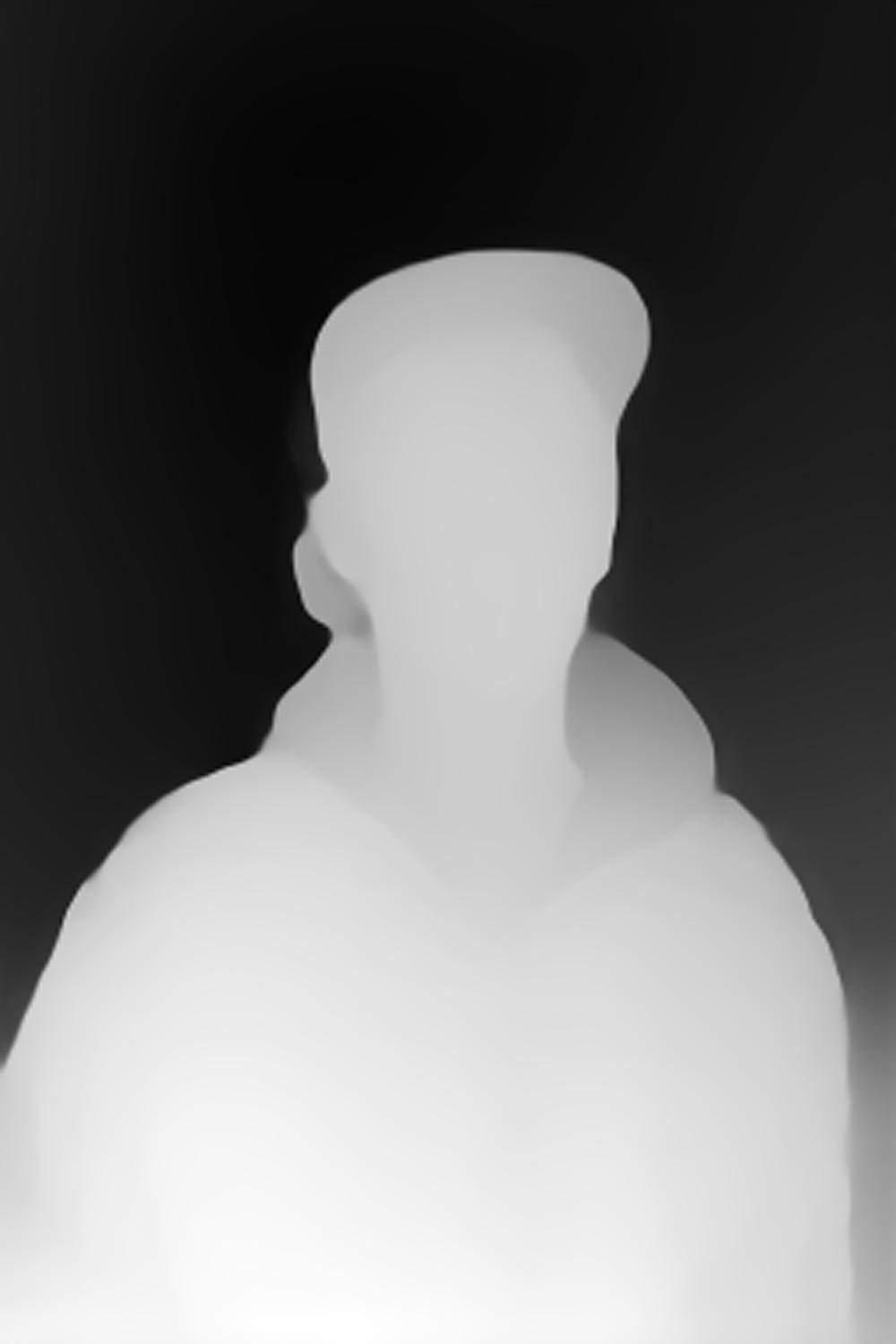
AI, algorithms, and digital technologies already govern a large part of everyday life – mostly without our awareness. Photographer and artist Carola Lampe has been exploring this development in her work for years. Her project Tell Me What To See presses reality and artificiality so close together that the line between them blurs. Fotografiska Berlin will present the work starting 14 August as part of Emerging Berlin, its program for up-and-coming artists.
Q&A with Carola Lampe
How did Tell Me What To See come about?
Lampe: There’s a prehistory to it. My last project was called Humanoid – that was the first time technology came into my work. I’d decided to go out and see where, in my immediate surroundings, I could find science-fiction images: places where the future was already visible in the present. I wanted to build worlds that were slightly dystopian. Tell Me What To See starts from there. I wanted to look more closely at how new digital technologies are influencing our perception, our everyday lives, and our world – specifically when it comes to algorithms, data, and AI.


So we’re talking about a dystopia again?
Lampe: With Humanoid, it was more straightforward. That was a consciously dystopian project. With Tell Me What To See I want to keep it somewhat open, let the viewers make up their own minds. From my perspective, it does tend that way. I see certain developments I can’t unreservedly get behind. I have a background in software development, so I know the field from the inside, and I’m critical of a lot of what goes on there.
Today we encounter AI in the news almost daily, in all kinds of forms. You started working on this project when it was barely being discussed …
Lampe: That’s right. I started the project at the end of 2019, into early 2020. When ChatGPT came out at the end of 2022, the subject suddenly reached a broad audience. My argument had been there before any of that: that our lives are being steered more and more by algorithms, across all kinds of areas. And most of the time we don’t even register it.
What were the questions driving you?
Lampe: I was driven by the fact that tech companies and governments are taking on too much control. That the data most systems rely on comes from the past, which means they can amplify existing biases. That filter bubbles develop, that mass surveillance becomes viable, and that the boundary between truth and fabrication keeps getting harder to draw. The core questions are: Can we still trust what we see?
Are we creating a different reality for ourselves? Who is in control, and what is left of freedom? I wanted to put reality and artificiality in direct tension and show how these shifts happen: in perception, in the social fabric, in the cityscape, in working life, perhaps in cognitive processes as well.
You worked with three different modes of image generation. What did that process actually look like?
Lampe: The first layer was classic street photography. I went out and searched for images that could visually anchor the project’s theoretical foundation. The second layer: I built small setups in the studio and tried to create images where you can no longer tell whether they were actually photographed or computer-generated.
The third is a more experimental approach: AI-generated images, screenshots of 3D environments, and manipulation through Photoshop and AI tools. What attracted me to this process was the contradiction. I come from software development, but in this project, I consciously work with the camera, producing images that look machine-made, yet doing so with a comparatively traditional tool. That ambiguity was deliberate.
Was it strange to have a purely machine-based sparring partner?
Lampe: Not really. I studied art, spent years working in performance and dance, but technology has always been there in parallel. The combination felt like a logical one. Though it did produce a kind of conflict: knowing the technology and being able to use it, I kept feeling I should be leaning on it far more than I actually did. I tried working with my own training data and language models but eventually lost interest in that direction. Even so, I continually had to reaffirm my decision to keep things less technical.
Will people looking at the work be able to distinguish the AI-generated images from the rest?
Lampe: In some cases, yes, with close attention. But there are images where it’s genuinely not clear. And that’s by design: you’re standing in front of something, simply not knowing what you’re looking at.


When you began, AI-generated imagery was a niche topic. Today it’s everywhere. Do you think that shift has affected how your work is received?
Lampe: It’s difficult to say. The subject is the same, but the context has changed dramatically. AI-generated images are now everywhere: in art, in photography, in daily life. I can imagine that the work is more immediately accessible today, because the topic has become familiar to so many people. That’s one of the reasons I’m curious about this show. You’ll have to ask me again afterwards.
How did it feel to immerse yourself so deeply in these questions around freedom and control? Does reality look more frightening now?
Lampe: These questions have been with me every day since the beginning. I read constantly, track the developments. At times, I feel it’s almost too much to be exploring these issues artistically on top of everything else. But it genuinely fascinates me. Certain areas leave me worried, I won’t deny that; not so much because of working on the project, but because of living with the subject matter more broadly. Still, I don’t want to spiral into depression over it.
Do you see this as something that can still be stopped, or is it simply inevitable?
Lampe: This development can hardly be stopped now. The economic and geopolitical interests at stake are simply too great, and the technology is being driven forward by an increasingly diverse range of actors.
But that does not mean we are entirely at its mercy. I do not want to write it off as straightforwardly negative. In fields like medicine, research and productivity, artificial intelligence has the potential to bring enormous benefits.
At the same time, the risks are substantial: power concentrating in the hands of a few technology corporations, new forms of surveillance and disinformation, and a growing dependence on digital infrastructure. What makes this particularly troubling is that nobody can predict with any confidence where AI is actually heading. Our relationship to truth is already shifting. Images, voices and videos can no longer be taken at face value. And digital media are fundamentally reshaping our perception of reality.


What surprised you in the process of making Tell Me What To See?
Lampe: It was more of a confirmation than a surprise. Working with AI models reminded me once again how heavily AI depends on existing data and patterns. Working with very small datasets, I could see how quickly the model tended to reproduce its source material rather than move beyond it. What I found most interesting was not the question of whether AI is creative, but what it actually perceives. What does a machine see when it looks at an image?
Where we as humans recognize meaning, memory and mood, AI works with patterns, relationships and probabilities. The project ended up raising fewer answers than new questions, above all about the nature of perception itself and where human and machine vision part ways. What does a machine see, and how does that differ from our own seeing.
Exhibition: Carola Lampe – Tell Me What To See
Opening: 13 Aug 2026, 19:00
Runtime: 14 Aug – 20 Oct 2026
Place: Fotografiska, Berlin
ABOUT THE ARTIST
Carola Lampe is a visual artist and software developer based in Berlin. She holds a Master of Fine Arts and attended seminars over several years at Ostkreuzschule für Fotografie in Berlin. Her photographic work has been exhibited internationally, including the United Kingdom, the Netherlands, Sweden, Italy, Poland, Greece, Indonesia and Hungary. In 2022 she was a finalist for the PHMuseum Photography Award.

In 2021 she won the Open Call of Belfast Photo Festival, and in 2020 she was selected as an Emerging Artist for the PARALLEL European Photo Platform funding programme. Her work has been published in Público PT, Der Greif, PARALLEL Atlas and dienacht magazine, among others. At the heart of her artistic practice is an engagement with the effects of technological development on human life and an exploration of the boundaries between reality and fiction.
CREDITS
The exhibition was curated by Marie-Luise Mayer (Exhibitions Manager at Fotografiska Berlin), in collaboration with the artist, and produced in partnership with IFA Berlin and Volkswagen R, with the kind cooperation of photography print partner WhiteWall.
OPENING
Save the date: The opening will take place on 13 August 2026 at 19:00.
FOTOGRAFISKA EMERGING
Fotografiska Emerging is Fotografiska’s global initiative dedicated to discovering, supporting and amplifying the next generation of photographers and visual artists. The initiative operates through curated exhibitions in Stockholm, Berlin, Tallinn and Shanghai, alongside a global digital platform accepting submissions worldwide.
EMERGING BERLIN
Emerging Berlin is an Open Call hosted on the Fotografiska Emerging platform dedicated to supporting and showcasing upcoming image-makers with a distinctive visual language whose photographic practice embodies, represents and shapes a part of Berlin. Selected artists receive a solo exhibition in Fotografiska Berlin’s Graffiti Hall.
FOTOGRAFISKA
Fotografiska is the global destination for photography, visual art and culture. With locations in Stockholm, Berlin, Shanghai and Tallinn, Fotografiska presents rotating exhibitions and a dynamic events programme that celebrates creativity, innovation and diverse artistic voices through photography and visual storytelling.
Fotografiska Berlin
Oranienburger Str. 54
10117 Berlin
Opening hours: Daily, 10:00–23:00
Instagram: @fotografiska.berlin
Text by: Immanuel Ayx (he/him) & Selina Bauer (she/her)

You must be logged in to post a comment.