

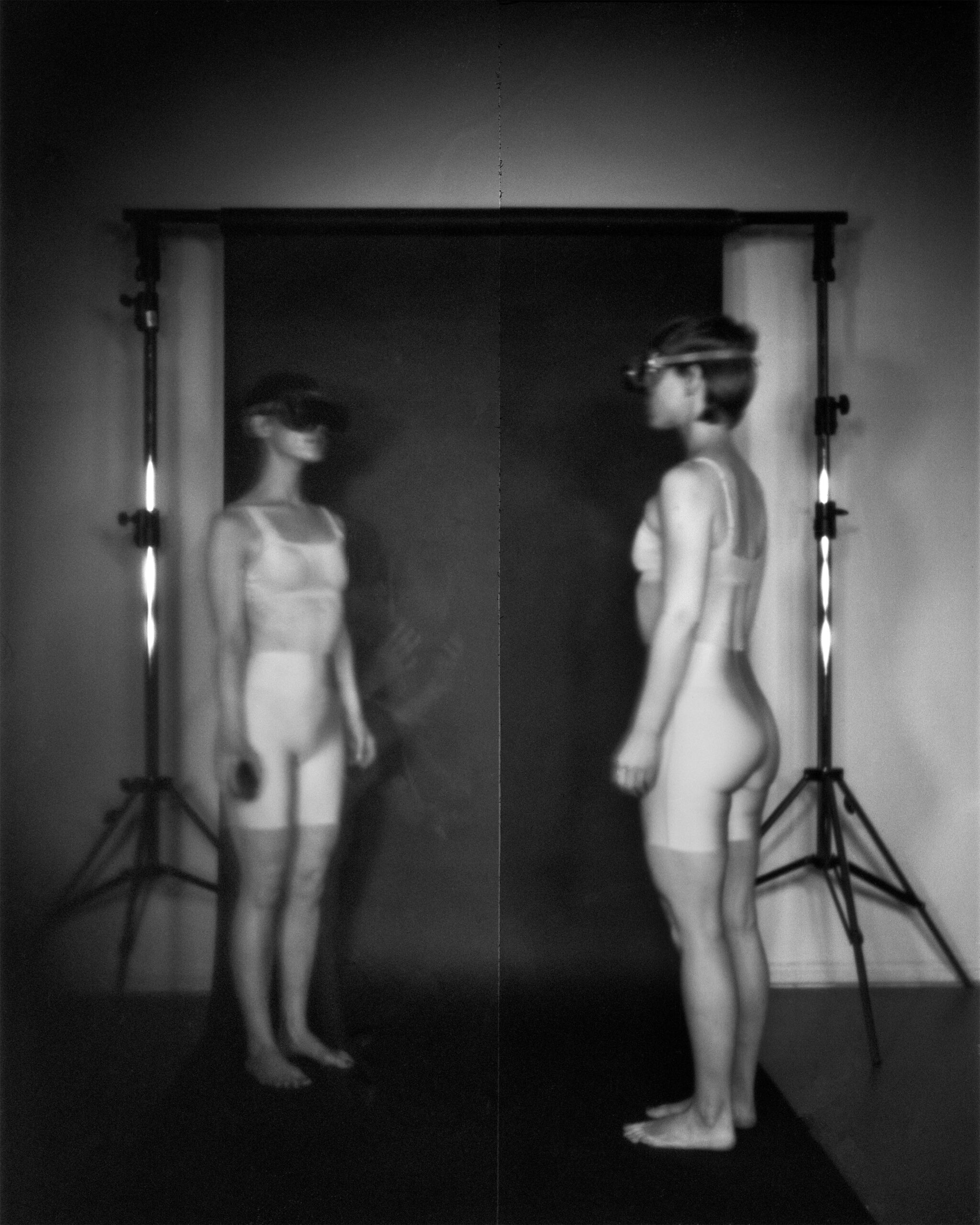
Exhibition: 587 Blitze (587 Flashes)
Opening: 5 June 2026
Runtime: 6 June – 12 August 2026
What is the essence of a selfie? What binds subject to object, human to technology? In 587 Blitze (587 Flashes), Berlin-based photographer Bob Jones explores the photographic self-portrait through an intense and radically physical process. Starting 6 June, Fotografiska Berlin presents the project as part of its talent program Emerging Berlin.

Interview with Bob Jones About The Origin of 587 Blitze
What was the idea behind 587 Blitze — and in what context did the work take shape?
Jones: 587 Blitze emerged from my diploma thesis at HGB Leipzig. At its heart, it was an attempt to create an image of myself using the photographic and conceptual tools available to me. I wanted to explore whether I could occupy a neutral position, even while being both the photographing subject and the photographed object at once.
I can already reveal one thing: the process made it clear that from an embodied, subjective perspective, a truly neutral self-representation is simply not possible.
Your work involved a technically demanding process…
It all started in December 2024 with the design and construction of custom pinhole cameras. Between then and March, a series of prototypes took shape before the actual photographic phase got underway in April.

Those weeks were defined by intensive studio sessions running alongside continuous darkroom work. The scale of the studio setup was a direct consequence of the technical specifications of the hand-built cameras. Their specific configuration also required a highly intricate flash setup to produce the results I had in mind.
Working with such extreme light must have been a challenge in itself?
Altogether, ten flash units were used, delivering a combined output of roughly 9,600 watts, the older units alone being extraordinarily powerful. Normally, photography is a purely visual experience, but at this intensity and in such close proximity to the light sources, it began to feel almost dangerous.
Several of the flashes emit UV radiation, and the sheer volume of light is enough to cause real sunburn. It was a tremendous challenge, and not just on a physical level. There was something genuinely eerie about spending weekends completely alone in that room at the university, enveloped by all that raw energy.
I found myself imagining that something was about to explode, or that the equipment might burst into flames. That undercurrent of uncertainty, that menacing atmosphere, ultimately shaped the work itself.
That kind of extreme experience seems far removed from conventional photography. What interested you about pushing photography that far?
That was exactly the point — to strip the process down to something essential and tangible. In my theoretical work, I engaged deeply with the smartphone as the dominant medium for self-portraiture today.
With a phone, the experience is barely physical at all; you see yourself instantly on the screen and can check the result right away. My project is a deliberate counterpoint to that.
The word “ritual” recurs throughout your accompanying material. What did this ritualized way of working look like in concrete terms?
For months, my days were defined by the same near-meditative sequence of actions: positioning the ten lights, loading the camera with the negative in darkness, assuming the pose, triggering the shutter, and finally making my way to the darkroom to develop the film.
Applying sunscreen was also a regular part of this routine.

Although rituals often carry a social dimension, this was a deeply solitary experience — yet one of extreme focus. What it demanded, above all, was presence and a full willingness to surrender to the situation.
Being exposed to an almost violent intensity of light and a constant stream of technical challenges gave the process a quality of the sublime. Over time, working with the apparatus and the light began to feel almost collaborative; not in any social sense, but as the other side of a highly intense, rule-bound negotiation with technology.
Another part of the work explores the intersection of analog and digital media. What was the idea behind taking smartphone selfies in darkness onto photographic paper?
The driving concept was radical simultaneity. At the very moment the smartphone flash burns my body onto the paper, my image is simultaneously recorded digitally.
I experienced a strange sense of self-multiplication: I am physically present on the paper and already exist as a digital record at the same time. That feeling of disorientation was my primary inspiration.
I know it from everyday digital life, especially from Zoom calls, where you often find yourself wondering: where exactly is my body right now?

What was it like to be confronted with your own image so relentlessly?
In my private life I rarely take selfies or appear in front of a camera, so I had almost no sense of my current outward appearance. Seeing myself so frequently turned out to be a liberating experience.
There was no element of judgment involved: no question of “positive” or “negative,” just a quiet acceptance of what is.
That sounds like acceptance in a rather radical sense?
Absolutely. Normally, body image always feeds into how we perform in front of the camera. We try to present ourselves in a certain way, to refine or improve.
By choosing a camera without a viewfinder and a “blind” 3D scan, I consciously stripped away any opportunity to check or correct myself.
Looking back at the project as a whole, what ended up being completely different from what you had imagined at the start?
My initial idea involved a different kind of physical engagement. I was thinking about transformation through a more classical performance format. A brutal flash apparatus was never part of the picture.
And for all my knowledge of cameras, I genuinely hadn’t reckoned with how technically unforgiving pinhole portraiture can be.
But the real surprise was how intimate the whole re-engagement with the technology became. That it would affect me so personally — that I really hadn’t anticipated.

Credits
The exhibition was curated by Marie-Luise Mayer (Exhibitions Manager at Fotografiska Berlin) in collaboration with the artist, and produced in partnership with IFA Berlin and Volkswagen R, with the kind cooperation of photography print partner WhiteWall.
Emerging Artist Party
Opening Celebration — 5 June 2026, 8 PM
Together with cooperation partners Volkswagen R and IFA, Fotografiska celebrates the Fotografiska Emerging Initiative and five new artists from the Emerging Berlin talent program.
The evening will feature: Talks and artist presentations, Live music by B4MBI and a DJ set by Sandrino.
Sophia Emmerich, Lead Editor, among others, will speak about the vision behind Fotografiska Emerging — the institution’s global initiative dedicated to discovering, nurturing, and amplifying the next generation of photographers and visual artists.
Marie-Luise Mayer, curator of Emerging Berlin, will introduce the next five exhibiting artists of the local series: Bob Jones, Carola Lampe, Miji Ih, Anna Tiessen and Anya Tsaruk.
The night also marks the official launch of 587 Blitze, during which Bob Jones will read from her textbooks, an integral part of the exhibition itself.
About Fotografiska Emerging
Supporting the Next Generation of Visual Artists
Fotografiska Emerging is Fotografiska’s global initiative dedicated to discovering, supporting, and amplifying the next generation of photographers and visual artists.
The initiative operates through two complementary pathways: Curated exhibition programs in Fotografiska museums in Stockholm, Berlin, Tallinn, and Shanghai. As well as a global digital platform accepting submissions from photographers and artists worldwide.
Fotografiska Emerging reflects Fotografiska’s commitment to shaping the future of photography and visual art by supporting artists at pivotal moments in their careers, offering not only visibility, but also professional development, mentorship, and international exposure.
More Information: https://berlin.fotografiska.com/de

You must be logged in to post a comment.