

A project by STUDIOTAMAT
In Rome’s Flaminio district, STUDIOTAMAT unveils Casa Continua, a 115 sqm apartment entirely reimagined through a project that engages with the home’s layered history while opening it to new ways of living.
The apartment is situated in a refined residential building. The building’s character is already evident in the rationalist language of its entrance hall. Purchased by the owner more than thirty years ago, the home had gradually fallen out of step with the person living in it.
Fragmented rooms and rigid hierarchies no longer reflected a daily life shaped by movement, conviviality and sharing, nor the increasingly central role that cooking had come to play. The intervention therefore began as a broader realignment. It was a contemporary rewriting of the interior. This process restored a dialogue between the house and its inhabitant.

The Kitchen as the Social Core of the Home
Upon entering, the apartment reveals itself gradually through a continuous sequence of rooms connected by visual and physical thresholds. At the centre of this system lies the kitchen, completely rethought as the core of the home:
“The key focus of the project was to correct what the client described as ‘the most significant mistake’ of the house’s previous life: the downsizing of the kitchen. We reversed that logic, transforming it into the engine of conviviality — a dynamic volume from which movement can be observed and the life of the house can be joined without ever feeling apart from it.”
— says Valentina Paiola, STUDIOTAMAT


Enclosed by custom-made burgundy glazed partitions, the kitchen becomes a central volume that is both practical and relational, turning food preparation into a shared gesture connected to the rest of the home.
Continuity Through Material and Spatial Flow
Around this nucleus, the living area takes shape through the union of three former rooms. Each retains its own identity, yet all are held together by visual and material continuity. Underfoot, the original panelled parquet flooring has been carefully restored and runs uninterrupted throughout the space, while above, a fine burgundy line traces the walls, marking their height.
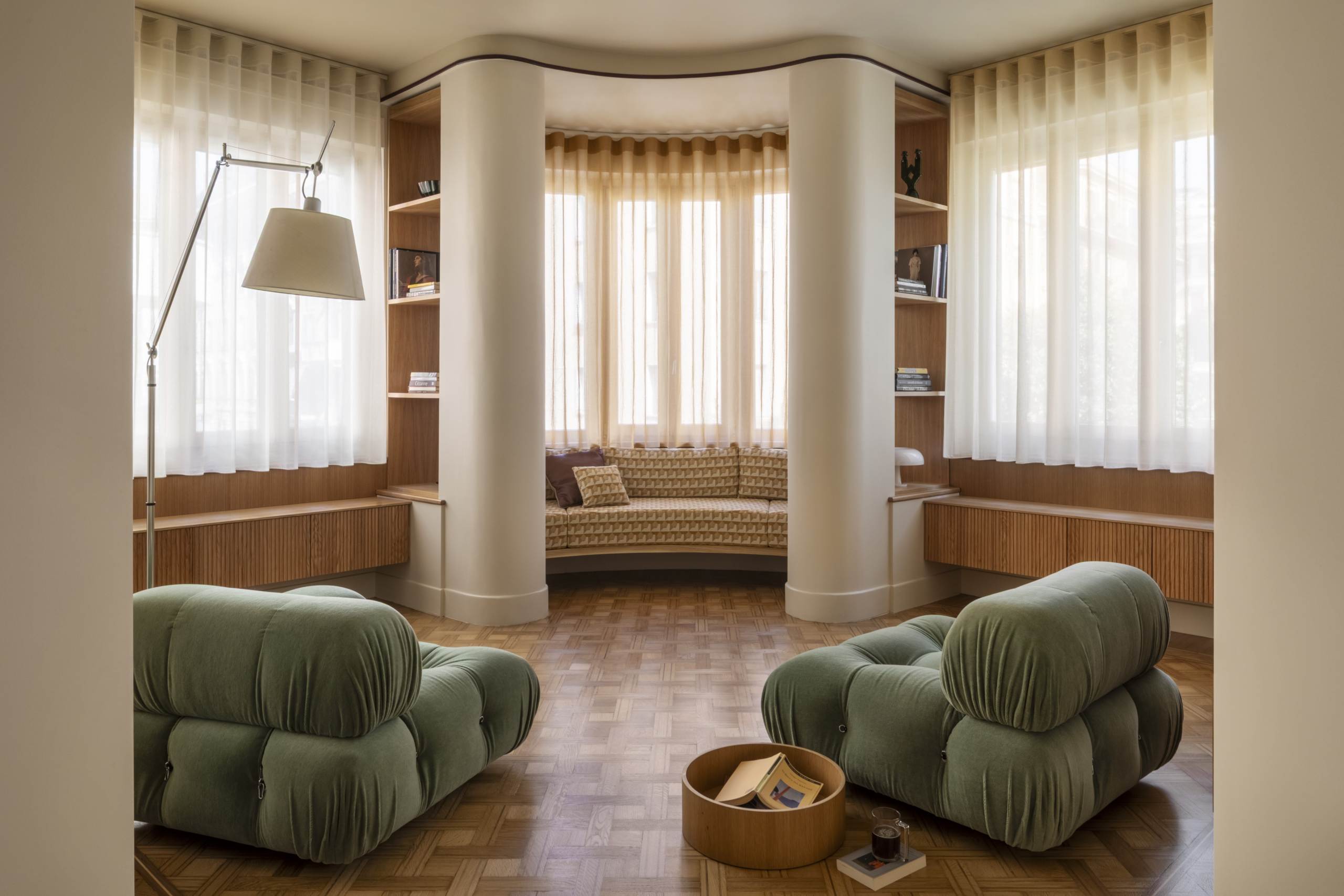
The apartment’s original geometry is embraced rather than concealed. Structural columns are integrated into custom oak joinery. This joinery houses bookshelves and built-in seating. It transforms a constraint into a functional device. This design organises space and encourages interaction.
Mario Bellini’s Camaleonda sofa in green velvet is in this setting. Bespoke benches upholstered in Relief fabric by l’Opificio echo the kitchen’s terrazzo floor geometry. This introduces a motif that reappears in a different chromatic variation within the reading room. The custom terrazzo flooring, designed with a geometric pattern, adds another layer of continuity between surfaces and furnishings.

A Permeable Threshold Between Functions
The dining room acts as a hinge between spaces. Here, the table and vintage Libellula chairs by Giovanni Carini occupy a room made permeable by reeded glass and burgundy metal partitions, which filter without enclosing and allow natural light to move freely throughout the apartment.


An Intimate Retreat Within the Open Plan
More intimate in character is the reading room, where the project shifts toward a tactile and secluded atmosphere. A custom book niche with integrated seating houses part of the owner’s extensive library. Here, tones deepen and the atmosphere becomes quieter and more protected.
The sleeping area maintains the same sense of rigour. Large bespoke oak wardrobes wrap the room, incorporating central panels upholstered in Filigrana fabric by l’Opificio. In contrast, the rear wall is finished in Harlequin’s Elsworthy Wide Width wallpaper. Its subtle organic pattern forms a backdrop to a Flou bed in ochre velvet. This bed is a chromatic accent that recalls the tones of the living spaces.


“The challenge was to give a home to thousands of accumulated books. We were not interested in creating an undifferentiated open-plan space, but rather a tailored sense of fluidity. From the custom terrazzo to the oak joinery embracing the structural columns, every detail was conceived as a prototype allowing the memory of Flaminio to coexist with a new everyday dynamism.”
— Valentina Paiola, STUDIOTAMAT


The result is a carefully balanced dialogue between permanence and transformation. Original elements such as the parquet flooring are reactivated through a new system of spatial and material interventions that redefine domestic life. A home emerges that adapts naturally. It welcomes and connects. It’s built around a renewed centre and a more fluid, living continuity. This home holds past memories while making room for new ones.
CREDITS
Project Name: Casa Continua
Location: Via Cesare Beccaria, Flaminio district, Rome – Italy
Architects: STUDIOTAMAT (Tommaso Amato, Matteo Soddu and Valentina Paiola), Alice Patrizi
Client: Private
Date: 2026
GFA: 115 sqm
Contractor: Ediltel B
Photographer: ©Serena Eller ©Ellerstudio
MINTLIST.INFO — IG — FB
Copyright © 2026, MINT LIST, All rights reserved

You must be logged in to post a comment.