

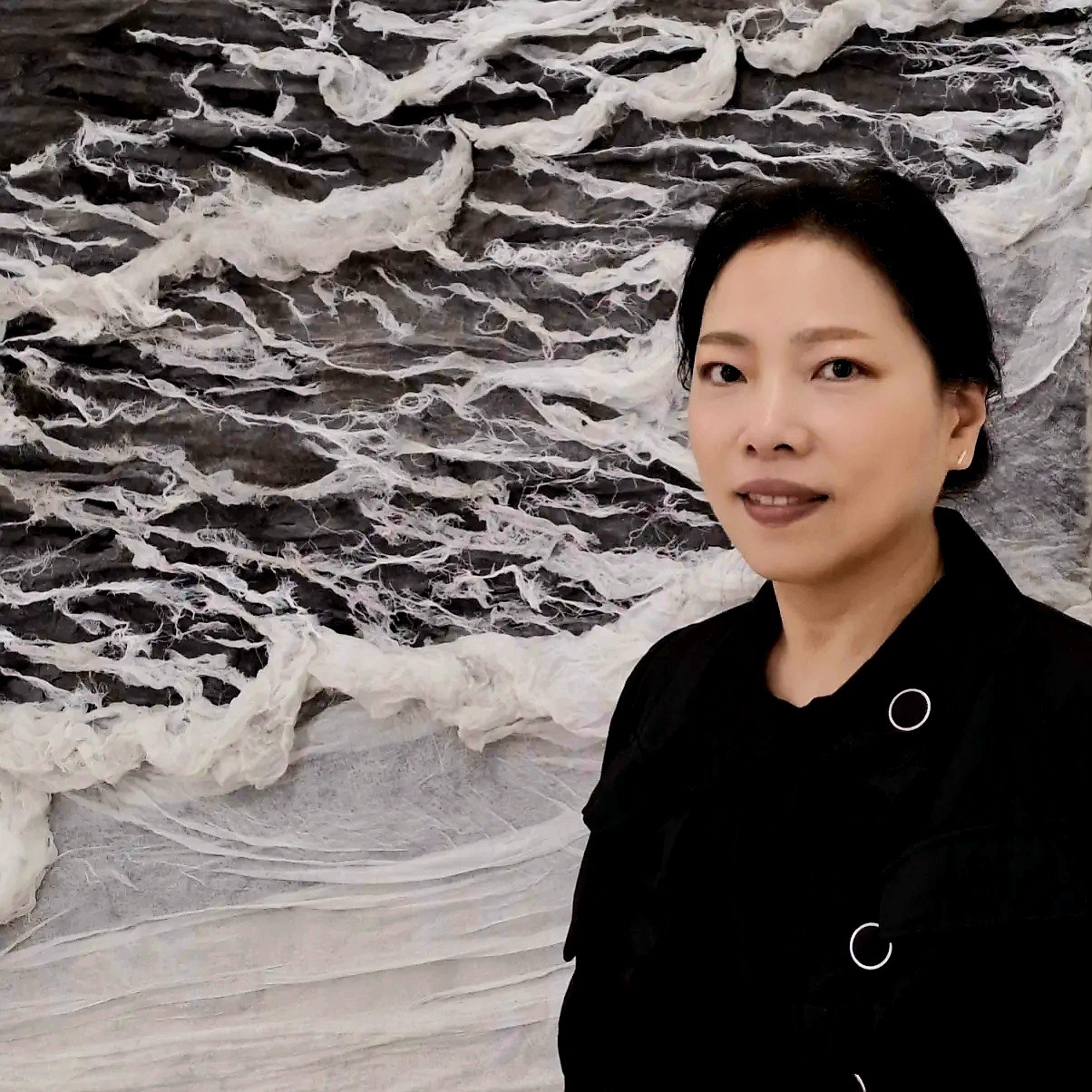
Based in Berlin since the 1990s, Seoul-born artist Jinran Kim has established an international presence, with major exhibitions spanning Tokyo, Seoul, Paris, and Berlin. She is known for works exploring war, destruction, and trauma. She has painted with ash, creating vast scenarios of bombed cities, including 1945’s Berlin. And she has assembled coffins crafted from bars of soap.
Life as a Short Excursion
Death is present in her current exhibition too, though in a different register. Monumental black-and-grey paintings evoke landscapes of ruins. Beside them are muted-color objects, nearly two meters high, which at first resemble paintings but reveal themselves to be deathbeds.
Kim has titled these works The Last Mattresses, dedicating them to the place where we take our final breath. Where does this fascination with death and dying come from?

“For me death is like a joyful return home. Life is a short excursion, and what remains at its end is the joy of coming home again.”
Jinran Kim
Milestones of a Journey
Her exhibition visualizes not only dying itself, but also the stages that precede it. Birth and marriage are the milestones, Kim says; at least that is how they are traditionally viewed in Korea.
Born and raised in Seoul, Kim has lived in Berlin for 30 years but continues to work regularly in Korea. Most recently, she contributed to the dazzling media façade of Seoul’s Lotte Tower, one of the tallest buildings in the world. This massive public project stands in stark contrast to the quiet atmosphere of the current exhibition, where she adopts a deliberately traditional aesthetic.

A miniature model of a Korean village allows visitors to glimpse what takes place behind tiny doors. Nearby stands a replica of the chest that Korean brides traditionally received upon marriage. Kim’s wedding chest is an elegantly curved piece of furniture made of precious wood, with a small oval opening at the top – for a video.
In Dialogue with Ulrike Ottinger
The video, filmed during a performance by Kim, is – though not exclusively – a response to the work of a German filmmaker whom she greatly admires: Ulrike Ottinger and her film The Korean Wedding Chest, which premiered at the Berlinale in 2009.
“Ulrike Ottinger developed an early and very earnest interest in Korea, its traditions, and also how they change. Today, Korea is popular thanks to K-pop and cinema, but when I came to Berlin, it was completely different. I felt like an alien. I am all the more delighted that she has allowed me to show her film in my exhibition.”
Jinran Kim
Kim’s own film — the video inside the wedding chest — shows a woman kneeling on a floor made of thousands of bars of soap, wiping it tirelessly with the same repetitive movements. Exercise in Futility is the title. Futile? Marriage, or life itself?

“It is a practice,” Kim says, “a practice on the way to where I am truly at home.”
That idea resonates throughout the exhibition. Death appears not as a rupture, but as part of a longer journey marked by birth, marriage, labor, and ritual. In Kim’s hands, the symbols of mortality never lose their gravity, yet they are stripped of finality. What remains is the possibility that the end of life may also be a return.
Jinran Kim: Silence and Eternity
Exhibition: May 29-July 3, 2026, Galerie Anna25
Schönleinstr. 25, 10967 Berlin
Special Event (Screening): Ulrike Ottinger’s “The Korean Wedding Chest” on Friday, June 26, 2026, at 7:00 PM
Registration required: koreakunst2026@gmail.com

You must be logged in to post a comment.