


Whilst museums and governments continue to debate the restitution of looted artifacts and colonial-era objects, a parallel discourse is emerging in the digital sphere. In Berlin, conceptual artist Sven Vollbrecht proposes an unusual gesture: the restitution of a web domain.
.COMpliance – A New Kind of Restitution
With his project “.COMpliance,” Vollbrecht claims legal ownership of the domain gallery-weekend-berlin.com and frames that possession not as speculation, but as temporary custodianship. The artist has announced that the domain will be ceremonially transferred to what he calls its “semantic home” on May 1, 2026. Until then, the web address functions as an empty exhibition space—a digital “white cube” documenting its own eventual return. The intervention raises a fundamental question: Can digital property be repatriated like cultural heritage?

From Commercial Asset to Social Sculpture
At the conceptual core of Vollbrecht’s project lies a reinterpretation of the idea of the social sculpture, developed by Joseph Beuys. Beuys famously expanded the notion of art beyond objects, proposing that society itself could become a creative medium. Vollbrecht translates this philosophy into the language of digital capitalism. A domain name—normally treated as a speculative asset—becomes the raw material for a conceptual artwork.
The project’s title, .COMpliance, deliberately plays on the dual meaning of compliance and the “.com” domain suffix. The work reframes internet infrastructure as both economic territory and cultural commons. By declaring himself a trustee rather than an owner, Vollbrecht transforms a commercial property into a participatory artistic gesture. The artwork therefore unfolds not only online but also through legal frameworks, symbolic acts, and time itself
Materializing the Internet
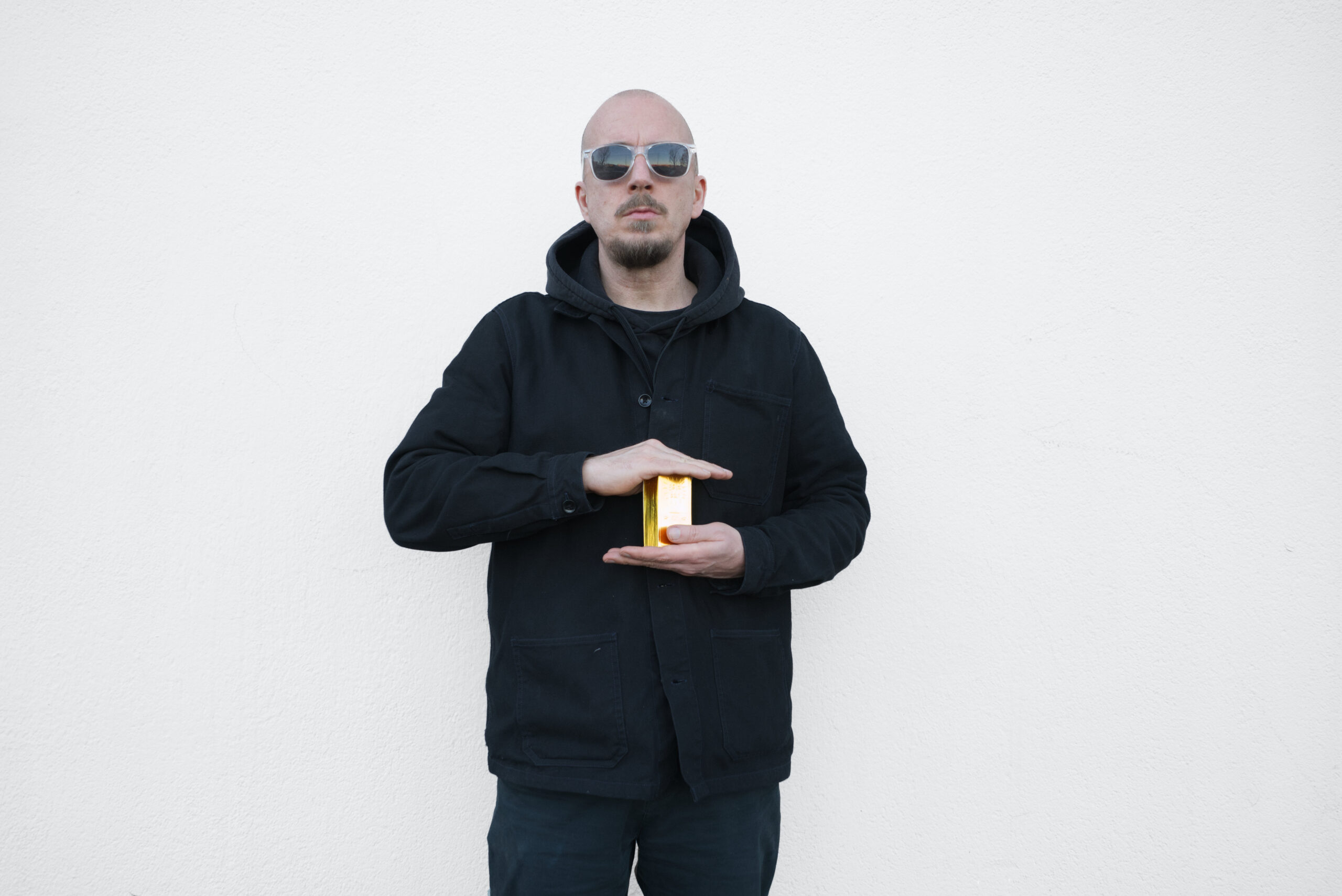
In order to give physical form to the otherwise intangible domain, Vollbrecht created a sculptural artifact: a gold-bar readymade containing the domain’s transfer code embedded within an invisible RFID chip.

The object functions as a material key to digital space. In practical terms, the authorization code—normally an alphanumeric string used to transfer domain ownership—has been converted into a physical medium.
The gesture echoes the readymade tradition initiated by Marcel Duchamp, while also referencing the symbolic value of gold as a traditional store of wealth. By combining both elements, Vollbrecht compresses several layers of meaning into a single object. The gold bar represents value, speculation, and permanence; the embedded RFID chip signifies the invisible infrastructure of information. And the domain’s auth-code embodies the legal mechanism of ownership. Together, they transform a simple artifact into a dense conceptual nexus linking materiality, technology, and legality.
The Domain as Exhibition Space
Until the scheduled transfer date, the domain operates as a neutral display environment. Instead of hosting a conventional website, it functions as a digital white cube, echoing the minimalist exhibition spaces associated with contemporary art.
Visitors encounter a live countdown marking the time remaining until the act of restitution. In this sense, the artwork is time-based and performative: the project only completes itself when ownership is relinquished.
The strategy recalls conceptual practices of the late twentieth century, where the artwork often consisted less of a physical object than of a process, instruction, or event.
Berlin and the Symbolic Geography of Art
The choice of domain is not accidental. Gallery Weekend Berlin, one of the city’s most prominent art events, takes place annually around May Day and brings together dozens of galleries across the city. The event has become a central fixture in Berlin’s contemporary art calendar, attracting collectors, curators, and international audiences.
By appropriating a domain that references this event, Vollbrecht inserts his intervention into the symbolic infrastructure surrounding Berlin’s art market. The domain itself becomes a site-specific artwork, operating within the linguistic and digital ecosystem of the city’s art scene.
In this context, the restitution planned for May 1—coinciding with the period traditionally associated with Gallery Weekend—acquires an additional layer of performative meaning.
A Practice Rooted in Conceptual Inquiry
Vollbrecht’s broader artistic practice revolves around examining consumer culture, societal structures, and the relationship between audience and artwork. His installations and participatory works often question how everyday systems—from food industries to media production—shape contemporary experience.
Before fully dedicating himself to art, he worked as a photographer and director in commercial media production. Since 2022, he has focused exclusively on conceptual artistic projects that blur the boundaries between economy, technology, and culture.
“.COMpliance” continues this trajectory by targeting a seemingly mundane yet powerful structure: the domain name system, one of the internet’s fundamental infrastructures.
Ownership, Language, and the Internet
Ultimately, Vollbrecht’s project operates in the space between law, language, and symbolism. A domain name is not merely a technical address but a linguistic territory—one that can be bought, sold, or strategically withheld.

By temporarily occupying such a territory and then relinquishing it through a public ritual, the artist turns the mechanics of internet governance into artistic material.
The countdown toward May 1, 2026 therefore functions as both a clock and a conceptual frame: a reminder that in the digital age, ownership itself can become a performance.
Leave a comment.