

In Blushing, Marta Djourina presents three new series of works, including folded analogue light exposure pieces and illuminated light boxes, continuing her ongoing investigation into the material, physical, and emotional dimensions of light. Djourina works without a camera. She uses laser pointers, color filters, movement, and direct exposure within the darkroom. These techniques create images that emerge through immediate interaction between light and photosensitive material.
The exhibition takes its title from the involuntary human phenomenon of blushing. This reaction is a bodily response that appears suddenly and uncontrollably. It often occurs before language. Blushing reveals an inner state through a visible transformation of the surface. It is both physiological and emotional, intimate and public. This tension between visibility and loss of control becomes central to Djourina’s artistic approach. The exhibition also draws on the paradoxical idea that humans continue to blush even in darkness, when unseen by others.
I was here
Blushing is a physiological process that is independent of visibility. Scientific research has demonstrated this fact. It suggests that the body reacts before social representation fully takes shape. This notion deeply resonates within Djourina’s practice, where light is understood not merely as illumination, but as an active and reactive force capable of triggering transformation.
In her works, photographic paper behaves almost like skin. Light penetrates, condenses, shifts into color, and leaves traces upon the material surface. The paper absorbs energy, records duration and movement, and stores the memory of physical interaction. Through folding, pressure, and exposure, the works emerge as both images and events — documents of a performative encounter between body, material, and light.

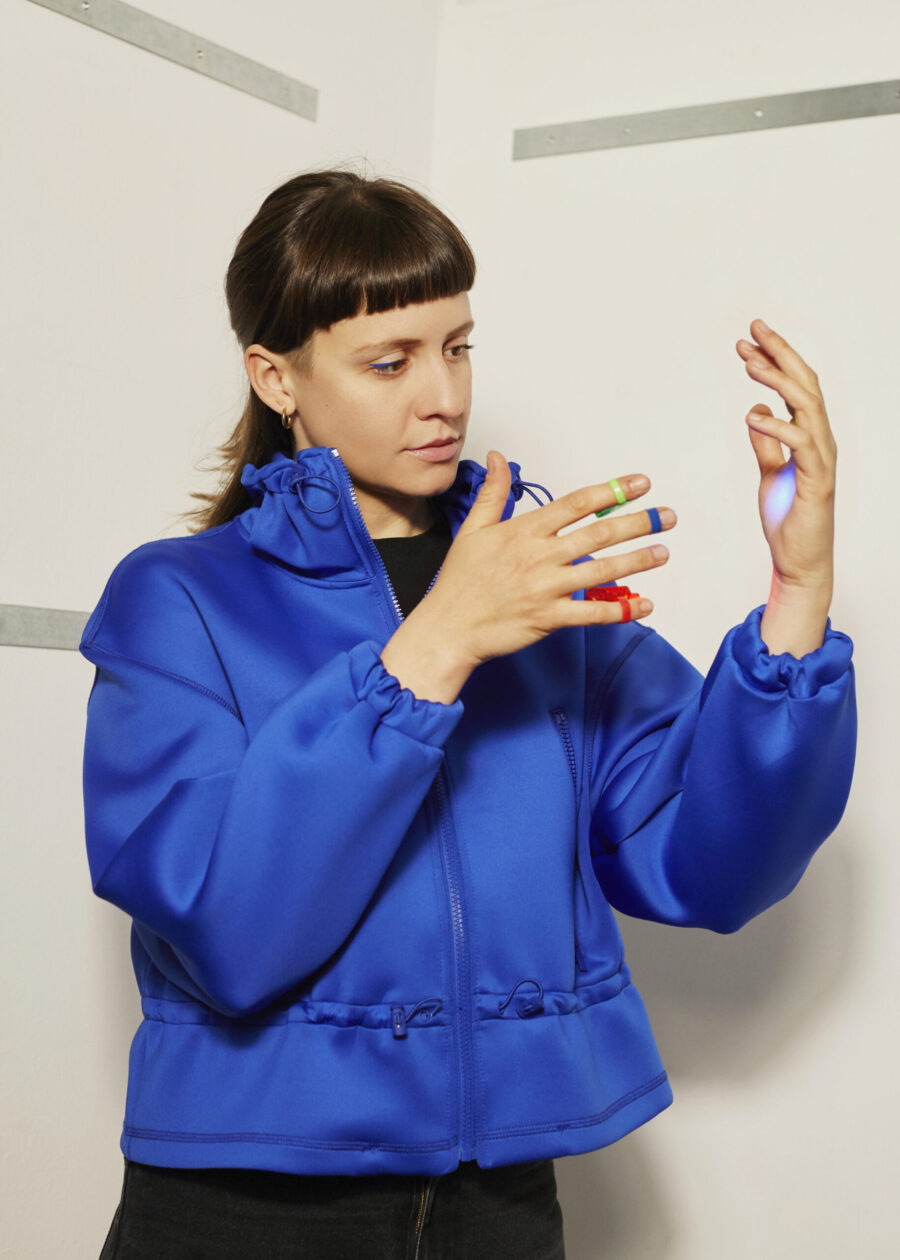
A recurring motif throughout the exhibition is the artist’s own hand. Appearing within the photograms as silhouette, filter, and gesture, the hand acts simultaneously as tool and trace. It shapes the paper before exposure, modulates the light passing through it, and remains visible as evidence of direct contact. The gesture carries both intimacy and assertion: a quiet inscription of presence — I was here.
choreographies of duration, movement, and spectral filtering
Djourina’s Folds series expands the analogue photographic surface into sculptural space. Folded, bent, and tensioned before exposure, the photographic paper becomes an active participant in the composition. The resulting creases and shadows generate spatial ambiguities in which surface and volume collapse into one another. Color appears unstable and atmospheric, produced not through digital manipulation but through precise choreographies of duration, movement, and spectral filtering.
The introduction of artist custom made LED light boxes further intensifies the relationship between image and illumination. Since the works themselves originate through direct exposure to light, the illuminated presentation allows light to re-enter the image, activating it once again. The works appear less as static surfaces and more as luminous bodies — fluctuating between object, image, and source.
Across the exhibition, Djourina approaches photography not as representation, but as transformation. Her works occupy a threshold between control and unpredictability, scientific precision and bodily reaction, visibility and sensation. Blushing proposes light as something deeply physical: a force that touches, alters, and reveals — even in darkness.

INTERVIEW FWR Gallery X MARTA DJOURINA
Your Berlin show is titled Blushing. What artistic concept does this title express?
For me, the title Blushing describes a moment of activation — a reaction triggered by an external impulse that manifests itself as a visible transformation. In my works, light appears not only as a means of illumination, but as an active and reactive force. It penetrates materials, condenses, shifts into color, and inscribes itself onto surfaces.
The image carriers react almost like skin — they “blush,” storing traces of intensity, time, and contact. I am interested in this analogy between bodily reaction and material-based processes: in both cases, a response emerges from an impulse that is neither fully controllable nor entirely accidental.
The immersive installation extends this idea into space. Architecture itself becomes part of the process, embodying light rather than merely displaying it. Between natural and artificial light sources, a field of tension emerges in which perception, material, and energy overlap. Blushing therefore understands light as something physical — a condition between visibility and sensation in which transformation can be experienced directly.
For those familiar with your artistic practice, a new iconic motif seems to emerge: the hand placed within your photograms, immersed in colored light ranging from warm red-orange to yellow or turquoise. Was the use of this motif planned, or did it arise intuitively through the action itself?
For several years I have been working with the idea of touch as an image-generating moment. In my practice, I use my own body as part of the process — the hand is a central tool within it. I press, shape, and tension the photographic paper, for example in the Folds series, before it is exposed.
The hand intervenes directly in the material — it structures the surface and determines how the light strikes the paper. When light passes through the hand onto the photographic paper, it also functions as a filter: it alters the intensity and spectral composition of the light and therefore influences the resulting colors.
The paper itself reacts to this intervention — it “blushes,” absorbs the energy, and stores it as a trace. I am interested precisely in this relationship between touch, formation, and reaction, in which the image not only emerges, but develops as a response to physical contact.
A large part of your artistic production takes place in the darkroom. That means you often work without a camera (“cameraless photography”). Using laser pointers and color filters, you act within the black box to inscribe the traces of your performative actions and movements into the light-sensitive surface of photographic paper. What fascinates you about this experimental process in relation to photography?
What fascinates me about cameraless photography is the direct relationship between light and material. There is no mediating system — the image emerges through immediate interaction. These processes are based on precisely developed procedures.
In the darkroom, I work with repeatable choreographies that I have developed over many years. This has resulted in a differentiated “catalogue of colors” that allows me to work specifically with intensity, duration, and movement.
What interests me is not chance itself, but the question of how control functions within the process — where it operates, where it shifts, and which parameters can be consciously directed.
New in this exhibition is the presentation of your images in LED light boxes. What intention lies behind this?
MARTA DJOURINA
For me, the presentation in LED light boxes is a consistent continuation of working with light. The images themselves were created through light — through direct exposure. Through the light boxes, light returns into the image and activates it once again.

A different mode of perception emerges: the works appear less like surfaces and more like luminous bodies. I am interested in this moment in which the image is not only viewed, but experienced as a source of light itself.
A classic element within your artistic oeuvre is the Folds series. Here, the transformation of the material through folding and light plays a central role. How do you decide which folds and structures emerge?
In the Folds series, I expand the analogue image space into a three-dimensional component. Before exposure, the photographic paper is folded, bent, or rolled, creating a sculptural surface that strongly influences the formal and chromatic composition. The edges create clear fields of color while simultaneously functioning as image-generating elements themselves.
Since the material is partially translucent, the individual exposures overlap and produce complex color constellations. At the same time, the physical structure of the paper creates its own shadows, which vary depending on the intensity and position of the light source. After exposure, the paper is unfolded again.
The real folds remain inscribed as lines, while their shadows persist as visual counterparts. This creates an ambiguity between actual structure and its representation — the image moves between surface and space.
Within contemporary art, when thinking about light as a medium, I first think of audiovisual artists such as Carsten Nicolai, who combines light impulses with sound frequencies on a scientific basis, or Ryoji Ikeda with his mathematically minimal light choreographies synchronized to sound. What motivated you to work with light? And what potential do you see in this medium for your future artistic projects?
My motivation for working with light is fundamental: without light, we would not be able to see. Our entire visual perception is based on it — for me, this makes light an existential point of departure. At the same time, my engagement with light has been strongly shaped by collaborations with scientific institutions. In projects related to optogenetics, I explored how light can be used to specifically steer and activate processes.
At the center of my work lies precisely this transition: when is light a medium of perception — and when does it become an instrument of intervention? In my work, I transfer this question into material processes. Light does not merely produce images; it actively intervenes in material, transforms it, and leaves traces behind. This is the potential I want to continue investigating in future works — especially within the tension between precision, control, and reaction.
About the artist:
Marta Djourina, (born 1991 in Sofia), completed her studies in art history at Humboldt University of Berlin (B.A.) and the Technical University in Berlin (M.A.) and in fine arts as a master student at the UdK Berlin. Since 2024 she is Artist in Research at the Royal Academy of Fine Arts in Antwerp and has been a guest lecturer at University of the Arts Berlin since 2020. Her works have been shown in numerous international exhibitions, most recently at MNAHA Luxembourg, Lage Egal Brussels, Haus am Kleistpark (Berlin), Sofia Arsenal – Museum of Contemporary Art, Goethe-Institut Bulgaria, ICA-Sofia, Berlinische Galerie – Museum of Contemporary Art, FeldbuschWiesnerRudolph (Berlin) etc.
Her works are in the collection of the Berlinische Galerie, the Eskenazi Museum of Contemporary art, Indiana University in the USA, IBB Berlin, EiB Luxembourg among others. She has received several awards. These include the EMOP Arendt Prize for Photography (2025) and the Presentation Grant for publications of the State of Berlin (2023). She was the AArtist in Residence of the Federal Foreign Office (2022) and won the Marianne Brand Prize for Photography (2022) and the BAZA Award (2021). Additionally, she received the Eberhard Roters Scholarship (Preussische Seehandlung Foundation, awarded at the Berlinische Galerie, 2020), among others.
Recidencies & Prices
In 2023, she spent 2 months at RU Residency Unlimited in New York. This was part of BAZA 2021. She also spent 3 months at Cité internationale des arts in Paris. This was part of the ADP Artist Development Program of the EiB Institute in Luxemburg. In 2024, she continued her work on extending the project “Fluid Contact” at a residency at Museum Landskorna Foto in Sweden. In 2025, she worked in Rostock in collaboration with the University of Rostock. This was on the occasion of the international year of quantum physics.
In 2024 Djourina published her first extensive monograph with DISTANZ Berlin, with texts by Gregory Volk, Babette Werner, Miriam Jesske and Dr. Sarah Frost, which has been translated into Bulgarian, German and English.
More about the exhibition: https://feldbuschwiesnerrudolph.com/
You must be logged in to post a comment.