

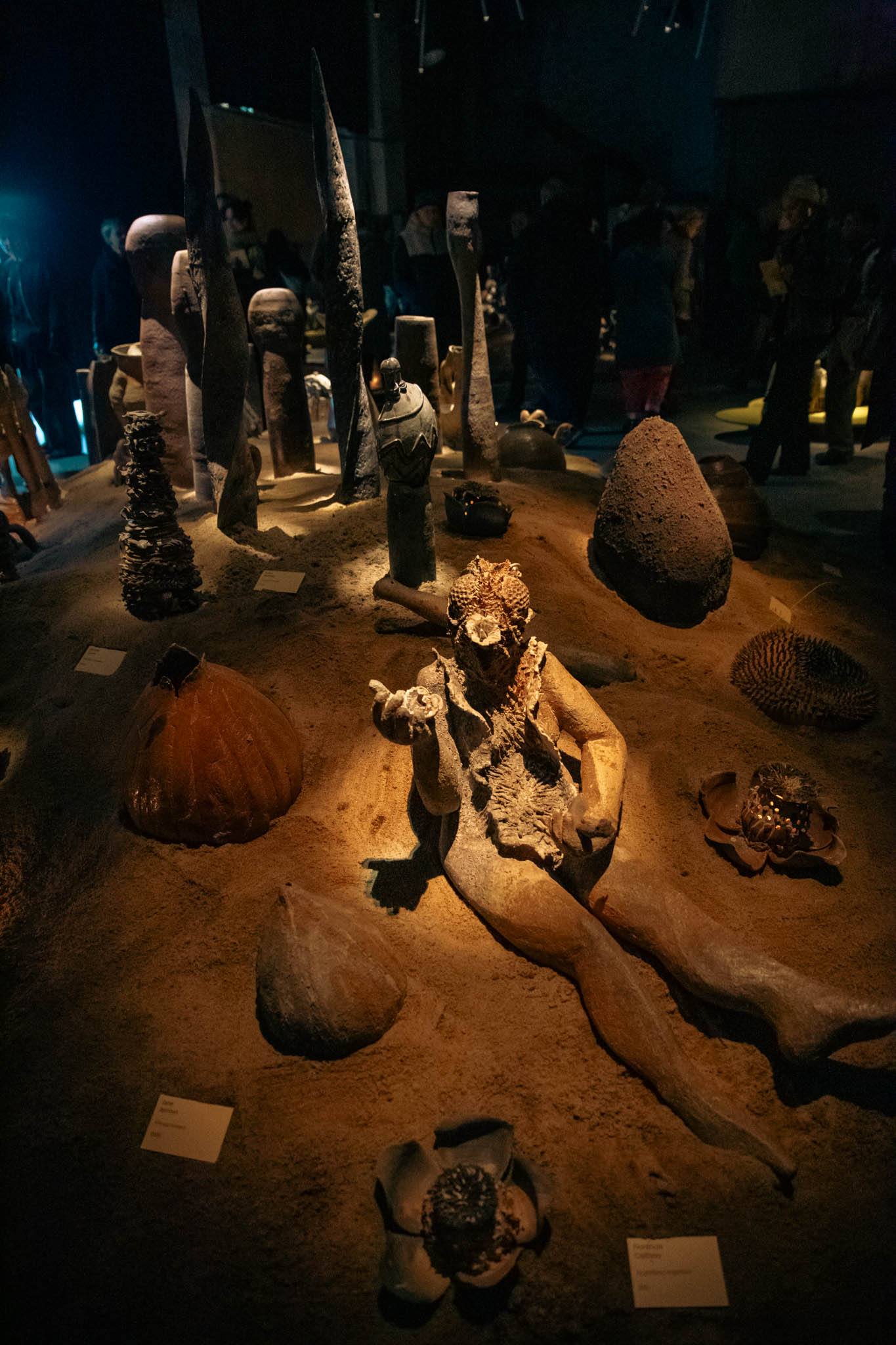
You enter into almost darkness. Knee-high dunes of sand fill the floor, from which mysterious forms emerge; vessels, limbs, small architectures. The effect is as though you have stumbled upon an eroding shoreline where ancient objects have resurfaced.
AFTER FIRE, AFTERLIFE, is a large-scale exhibition that opened this fall during the Tallinn Design Festival. The Festival, which focuses on promoting Estonian design, community, and craft, is the largest such festival in the Baltic region. It takes place every year in the Krulli Quarter, an old industrial complex in the north of Tallinn.


Curated by Estonian ceramicist Cristopher Siniväli, the exhibition celebrates 25 years of the international Kohila Symposium. Featuring nearly 120 works by 106 artists, the show is less a retrospective than a meditation on clay, fire, and community.
Founded in Kohila, Estonia, the annual symposium brings together eleven artists each year for an intensive three-week immersion in wood-fired ceramics. Over the years, it has hosted 230 emerging and established artists from 35 countries. The symposium centers around an anagama-type kiln, an ancient Japanese-style, single-chamber kiln built in a sloping tunnel shape. It is fueled with firewood, and the complex interaction between flame, ash, and the minerals of the clay forms a natural ash glaze. The firing takes place over days while the participants take turns stoking the fire. The experience is physically demanding, unpredictable, and profoundly collective.
distinctions between years, authors, and narratives.
That spirit is evident throughout AFTER FIRE AFTERLIFE. Rather than present the works as isolated objects, they are arranged in groupings that blur distinctions between years, authors, and narratives. It is not a traditional gallery setting but rather installed in an unused 19th century machine factory. Think old bricks, high ceilings, metal beams. Yet the area is in the process of being redeveloped as a new multi-use urban district. The sense of crumbling history was palpable in the setting, adding to the drama.
The exhibition’s strength lies in its ability to transform a vast archive into a cohesive experience that gives a weighty impression of time, material, and tradition. The dim light, sand dunes, and placement of the works create a dramatic environment in which viewers navigate a winding path between sand dunes. The uniformity of the ash-fire palette links disparate practices, emphasizing process and collaborative effort throughout the years.
Earth, Ash and fire
The majority of the pieces emerge out of the sand, but some are perched on brick ledges or on platforms tucked into dark corners. The result is mysterious and compelling. It is an environment that invites repeated wandering, encouraging viewers to circle the space multiple times, seeing more each round as your eyes adjust to the dim light.


In the end, AFTER FIRE, AFTERLIFE succeeds not because it documents the Kohila Symposium, but because it embodies over two decades of dedication to the ancient craft of ceramic wood firing and the community that carries it forward.
No one piece sticks out as memorable among the rest. The uniformity of the ash-fire glaze effect, together with the half-burried display means that the overall forms and distinguishing features of each piece were difficult to parse.
This is a disservice to the individual artist, but aids the curatorial aim of unifying the nearly 120 works and impressing a sense of collectivism. Nevertheless, there is a sense of deep respect for the processes that take place and connection to the natural elements, something that I found throughout my time at the Tallinn Design Festival.
Curated by Cristopher Siniväli
Editors Note: The exhibition AFTER FIRE AFTERLIFE was held from September 29 - October 19, 2025 as part of the Tallinn Design Festival in Estonia. https://www.disainioo.ee/
You must be logged in to post a comment.